By SUSAN JONES
A new 420-bed residence hall approved by the Pitt Board of Trustees last week will help address one big issue — the need for more student housing as enrollment increases — but will likely contribute to another problem — a shrinking number of parking spaces in Oakland.
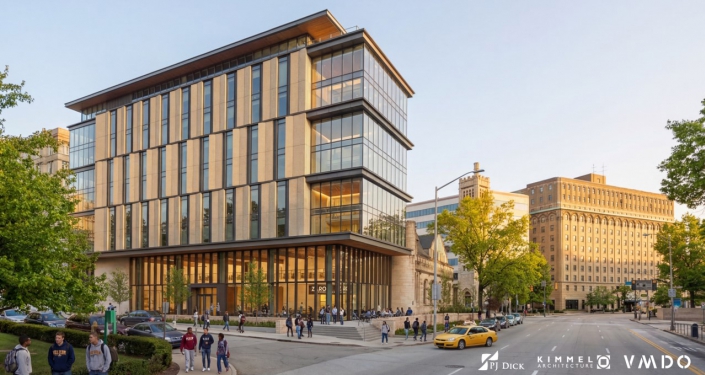
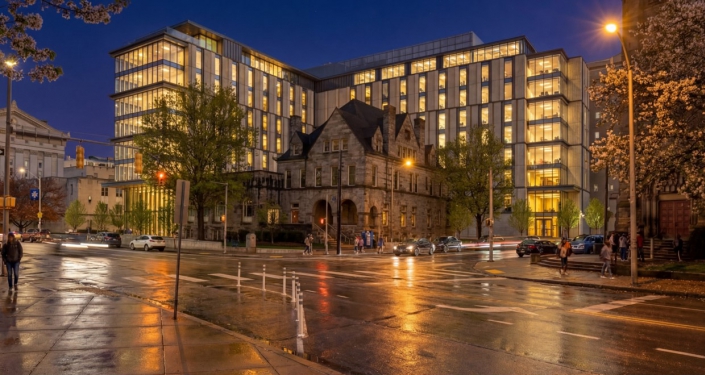
Construction will begin this summer, according to a Pitt spokesman, on the new building in what is now a parking lot surrounding the Music Building — bordered by Fifth, Bellefield and Ruskin avenues. The building is expected to open for the fall 2028 semester. The University declined to give the cost of the project.
“Institutional research and broader research shows that the performance and success of students with respect to retention and just their overall success academically is strongly correlated with on-campus housing,” Dwayne Pinkney, executive senior vice chancellor for administration and finance, said when presenting the resolution to the board. He noted this is particularly true for first-year students, who are the intended tenants of the new building.
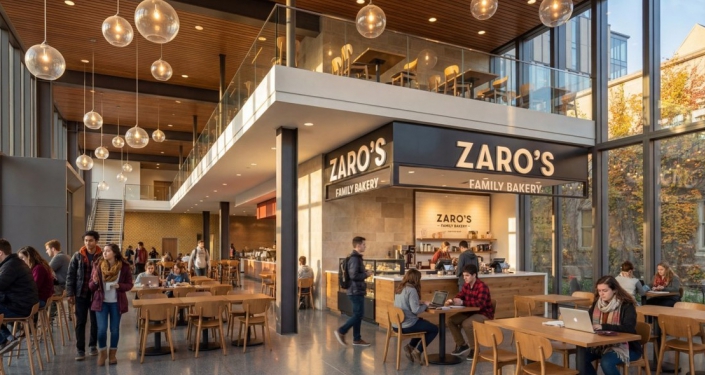
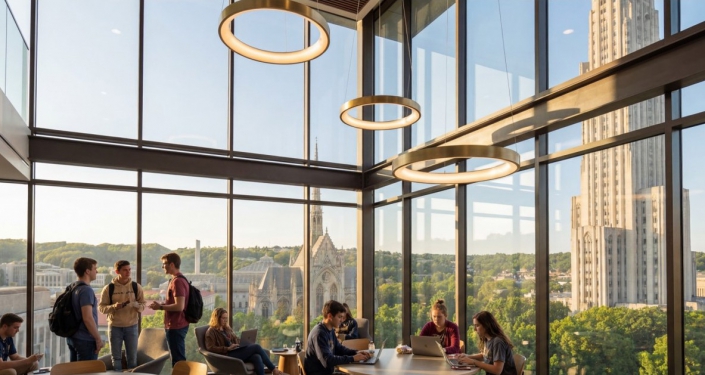
The new residence hall — the first since Nordenberg Hall opened in 2013 — will have dining facilities, faculty-in-residence spaces, study areas and spaces that can be flexed for use by Living Learning Communities. The building is expected to achieve LEED Gold certification by incorporating sustainable elements such as bike storage, stormwater collection, and energy and water performance that meet the University’s carbon neutrality goals.
Increasing need
The need for new housing aligns with the Plan for Pitt goal of increasing undergraduate enrollment to 22,000 by 2028. Marc Harding, outgoing chief admissions officer, said at a Senate Educational Policies Committee meeting last week that “we are on target to hit 22,000 or maybe a little bit over that by 2028.”
Last fall’s largest first-year class ever of around 5,800 students resulted in Pitt leasing space for 400 more beds over three different locations in Oakland — The Hampton Inn on Hamlet Street, and the Pennsylvania and Webster apartments on Dithridge Street — as well as adding nearly 300 beds at Pitt-owned buildings by converting some doubles to triples and triples to quads.
Pitt also leases housing space at the Bridge on Forbes — a four-year lease signed in 2024 for 230 beds and an option for 50 more — and the Wellington Apartments on Melwood Avenue — a five-year lease signed this year for 148 bed. These are mostly for upperclassmen.
All of these spaces, except for the Webster apartments, will be used again by Pitt this fall. The University is currently evaluating the number of students that may be placed at the Hampton Inn for the upcoming academic year, a University spokesman said. He declined to reveal the cost of the leases.
Pinkney told the Board of Trustees that “despite how helpful those block leases are, and they are helpful, they are not a viable long-term strategy. Our plan is to build and be able to house students on campus in our facilities, at which time we’ll be able to move away from the block leases, but they are an important instrument that we do use, and they help us in the transition.”
While Harding said there’s “no way” Pitt is planning to enroll as big a freshman class this fall as in 2025, there still will be a demand for housing. The target is now around 5,200 students.
“This is a good challenge for the University to have,” Trustees Chair John Verbanac said at the meeting. “It is an affirmation of the demand for a Pitt education and our need to continue to accommodate the marketplace and continue to provide the level of education that’s had us buck what many talk about as a national trend and demographic cliffs that exist. A University of Pittsburgh education has never been in higher demand.”
Campus Master Plan
The residence hall is the first approved project from the new Campus Master Plan.
Late last year, Carolyn Verga, assistant vice chancellor for campus planning, said this project gained some momentum both because of the need for student housing and because the site is the easiest to work with. “We don’t have to tear anything down. We don’t have a lot of enabling projects associated with it,” she said.
There is one small structure on the site — a one-story pre-fabricated building that is currently used by academics in the Dietrich School of Arts and Sciences. They will temporarily relocate to the Fifth and Halket building for the summer and then move to Crawford Hall, the University spokesman said.
The project also was included in the 30-year Campus Master Plan that Pitt debuted in 2018 and has already gone through the Institutional Master Plan process required by the city.
The team of PJ Dick, VMDO and Kimmel Architecture was selected through a competitive design-build process — the first time the University has used this approach.
The selection process narrowed 10 potential design-build teams to three competition finalists. The competition involved site tours, meetings on safety, workforce development, extensive faculty and staff engagement, and student listening sessions.
What about parking?
What remains unclear is what, if anything, will replace the 56 parking spots now available in the RA Lot that surrounds the Music Building.
No date has been set yet for when the lot will close to daily and permit parking.
A Pitt spokesman said, “The University is evaluating parking needs and options as part of the project planning process and Campus Master Plan.”
The Board of Trustees was told that those with leases in the lot will be moved to other campus locations.
In the past several years, the demolition of O’Hara Garage, along with other changes, resulted in a net loss of roughly 660 spaces. In addition, street parking along Fifth Avenue has been severely impacted by construction projects, such as the new UPMC Presbyterian hospital tower and the PRTX University line for a bus rapid transit system.
Another issue is how construction of the building will impact vehicle lanes on Fifth Avenue, which is already dotted with construction projects from Bellefield to Craft Avenue.
The University spokesman said the builder PJ Dick is working with the city’s Department of Mobility and Infrastructure and others on the site logistics plan.
“While the site is under development, we expect one lane of Fifth Avenue to be closed for safety. The University is committed to minimizing disruptions and will provide regular updates to the campus community throughout the project.”
Fifth Avenue also will face even more traffic this summer during the planned 28-day shutdown of the Parkway East from July 10 to Aug. 3. The preferred detour for those heading to and from downtown is along Penn Avenue and Fifth/Forbes avenues depending on direction of travel. PennDOT estimates that 100,000 vehicles use the Parkway East each day.
Susan Jones is editor of the University Times. Reach her at suejones@pitt.edu or 724-244-4042.
Have a story idea or news to share? Share it with the University Times.
Follow the University Times on Facebook.