
By SHANNON O. WELLS
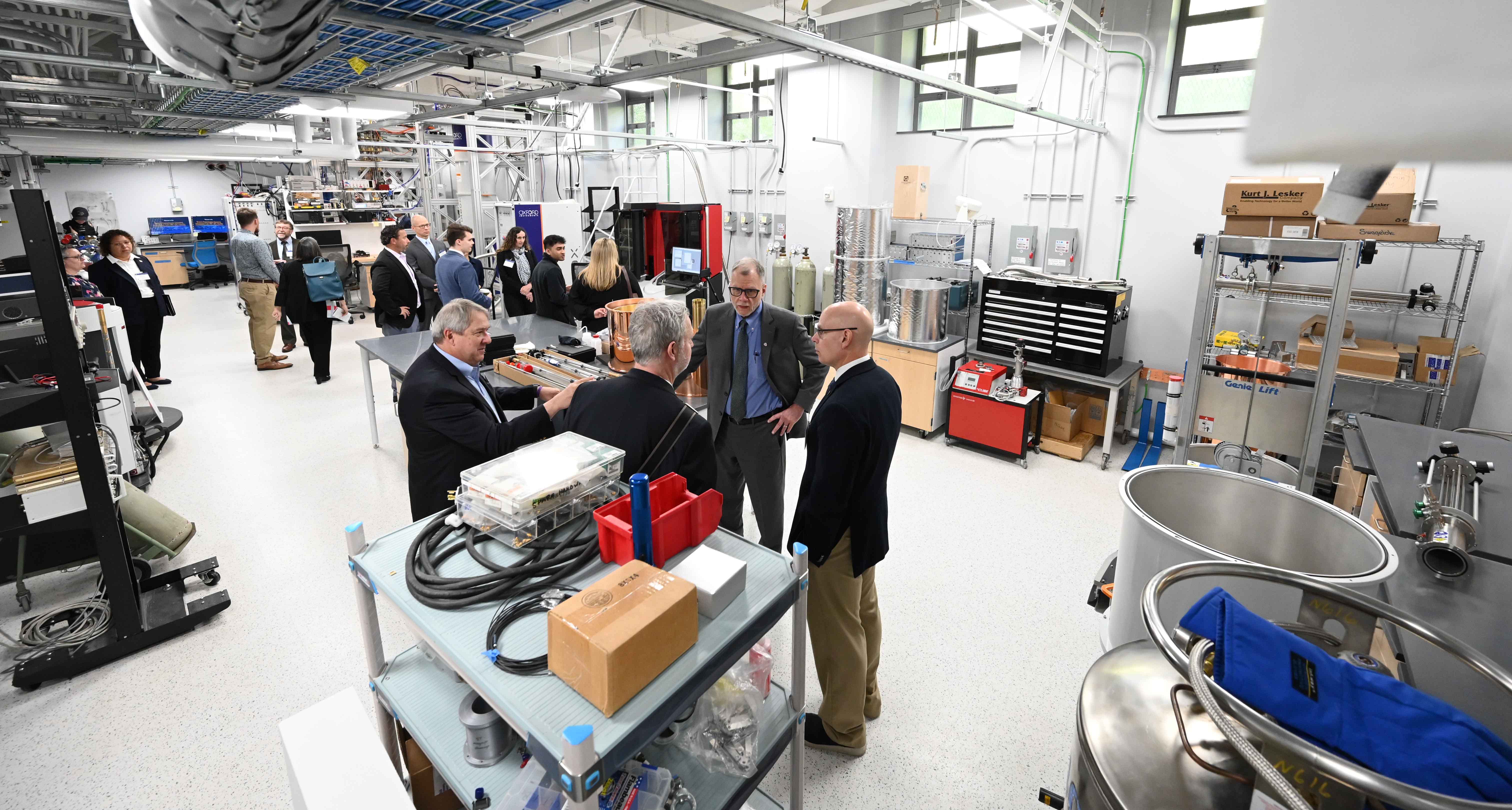
In a lab in Pitt’s Old Engineering Building, a newly installed stainless-steel box called a dilution refrigerator can cool its contents to 20 millikelvin, or 20 thousandths of a degree above absolute zero.
“It’s not the kind you have in your kitchen,” noted Adam Leibovich, dean of the Dietrich School of Arts & Sciences and former director of the joint Pitt-Carnegie Mellon Pittsburgh Quantum Institute (PQI), of the fridge designed to reach “the coldest temperature the universe allows … much colder than even the temperature of deep space.”
 At this temperature, “the quantum mechanical nature of matter becomes manifest. Particles like electrons or helium atoms do not look at all like classical objects we’re used to,” he continued. “They can be in two states at once. They can be in two places at once. They can pass through classically impenetrable barriers. They can become entangled, linked across space in ways that Einstein famously called ‘spooky action at a distance.’ New states of matter arise.”
Rather than some kind of metaphor, he emphasized, “this is physics. And it is the physics that Dietrich School faculty have been working to understand, harness and ultimately build with for decades.”
Leibovich shared such heady descriptions as part of a ribbon-cutting ceremony for the Western Pennsylvania Quantum Information Core (WPQIC) Facility on May 4 in the Old Engineering Building. The event featured leaders such as Chancellor Joan Gabel and Pittsburgh Mayor Corey O’Connor, along with Rob Rutenbar, senior vice chancellor for Pitt Research.
Others in attendance included Michele Manuel, dean of the Swanson School of Engineering; Bruce Childers, dean of the School of Computing and Information; and former Pitt Chancellor Pat Gallagher, professor in the Dietrich School’s Department of Physics and Astronomy.
Established through an $11.6 million loan from Pitt’s Strategic Advancement Fund, WPQIC represents a cross-disciplinary, multi-institution effort intended to position Pitt and its partners at the forefront of the quantum physics field, as Pittwire reported in 2023.
The facility — a tightly packed five-station lab which accommodates systems for probing electrical, magnetic and quantum properties at cryogenic temperatures — creates a hub for students, researchers and industry partners to “come together to forge the underpinnings of a stronger quantum information science and engineering discipline,” WPQIC’s mission statement says.
WPQIC, as Leibovich elaborated, gives Pitt’s quantum physics work “a new home and a new toolkit” by bringing together faculty, students and partners to collaborate in “a space designed for sharing ideas and learning from one another. It lowers barriers, it speeds innovation and invites collaboration,” he said.
In his welcoming introduction, Rutenbar explained that the new lab’s acronym, WPQIC — for practical purposes, at least — is pronounced “whip quick.”
“The engineering team spent a lot of time on this,” he quipped. “Everybody say it with me now …”
Taking a more studious tone, Rutenbar said WPQIC builds directly on the foundation of the Pittsburgh Quantum Institute, which for more than 10 years has helped “not only bring the area’s quantum community together, but also helped provide major results.”
Augmenting the initial, $11.6 million loan, Pennsylvania Sens. John Fetterman and Dave McCormick obtained an additional $400,000 congressional earmark for purchasing equipment that Rutenbar called “vital” for the core operation. “We thank the senators for recognizing this need and investing in a huge scientific opportunity for our region and for our nation.”
The quantum lab now helps the entire region “level up,” giving Pitt researchers a “more comprehensive, integrated platform for quantum experimentation — from fundamental physics to emerging applications,” he said. This enables quantum researchers to go “end to end in one place to synthesize and refine quantum materials” to fabricate nanoscale devices and characterize those devices “under the very extreme conditions that quantum systems demand.”
Game changer
Noting that the Swanson School of Engineering has been part of Pittsburgh industrial story for over 150 years, Dean Michele Manuel said the school has “always been at the intersection of discoveries within the institution and within our region. Quantum research is the next chapter of our story.”
She cited work by Kevin Chen, professor of electrical and computer engineering, to build quantum photonic sensors using laser and fiber optics. “These are not laboratory curiosities,” she said. “They can withstand the temperatures inside of a nuclear reactor and monitor a pipeline from miles and miles away.”
The “new frontier” of quantum computing as an engineering tool, she said, includes research with NASA on algorithms that use quantum computers to simulate turbulent fluid flow — “a complex problem that even our best supercomputers can only approximate.”
“The promise is that a quantum computer can solve these problems that a classical computer could only approximate,” she said. “… This has the potential to impact not only the aerospace fields and technology, but also automotive aerodynamics, climate modeling, renewable energy and bioengineering.”
Noting that the “quantum industry is hiring,” engineers are needed “who can build, test and deploy these technologies,” she added. “And for our faculty recruitment, a facility like this is a game changer.”
‘Top of the list’
Chancellor Gabel, in her remarks, called the dedication of the quantum lab “an important day … for our city, for our region, for the state and beyond.
“It’s an important day for our vision as a University, what we capture when we say ‘It’s Possible at Pitt,’ what it means to play to the strengths of the intellectual capital of our faculty, staff and students, and also what we hope to accomplish in service to our community by leaning into all of this intellect (and) opportunities that it presents for everyone,” she said.
The lab, she added, is about “moving from this very esoteric idea that some people understand and some people don’t, but everyone recognizes is really important for action.”
Noting that its establishment “could not be more timely,” Gabel cited fiscal-year research and development priorities released last September by the offices of Management and Budget and Science and Technology Policy.
“Quantum science was at the very top of the list — one of the highest priorities for emerging technology support, second only to artificial intelligence,” she noted, “with obviously a very strong bridge between the two.”
Gabel extended thanks to Rob Cunningham, vice chancellor for research infrastructure, for his operational leadership in bringing the project to life, and other involved faculty for “what we know is going to be coming for the future as a result of their insight, expertise and passion for this subject.”
She also expressed appreciation to Carnegie Mellon University for its “commitment to co-funding and co-leading this institute,” along with Mayor O’Connor and elected officials including Fetterman, McCormick and Gov. Josh Shapiro. “We’re very grateful for what their support means.”
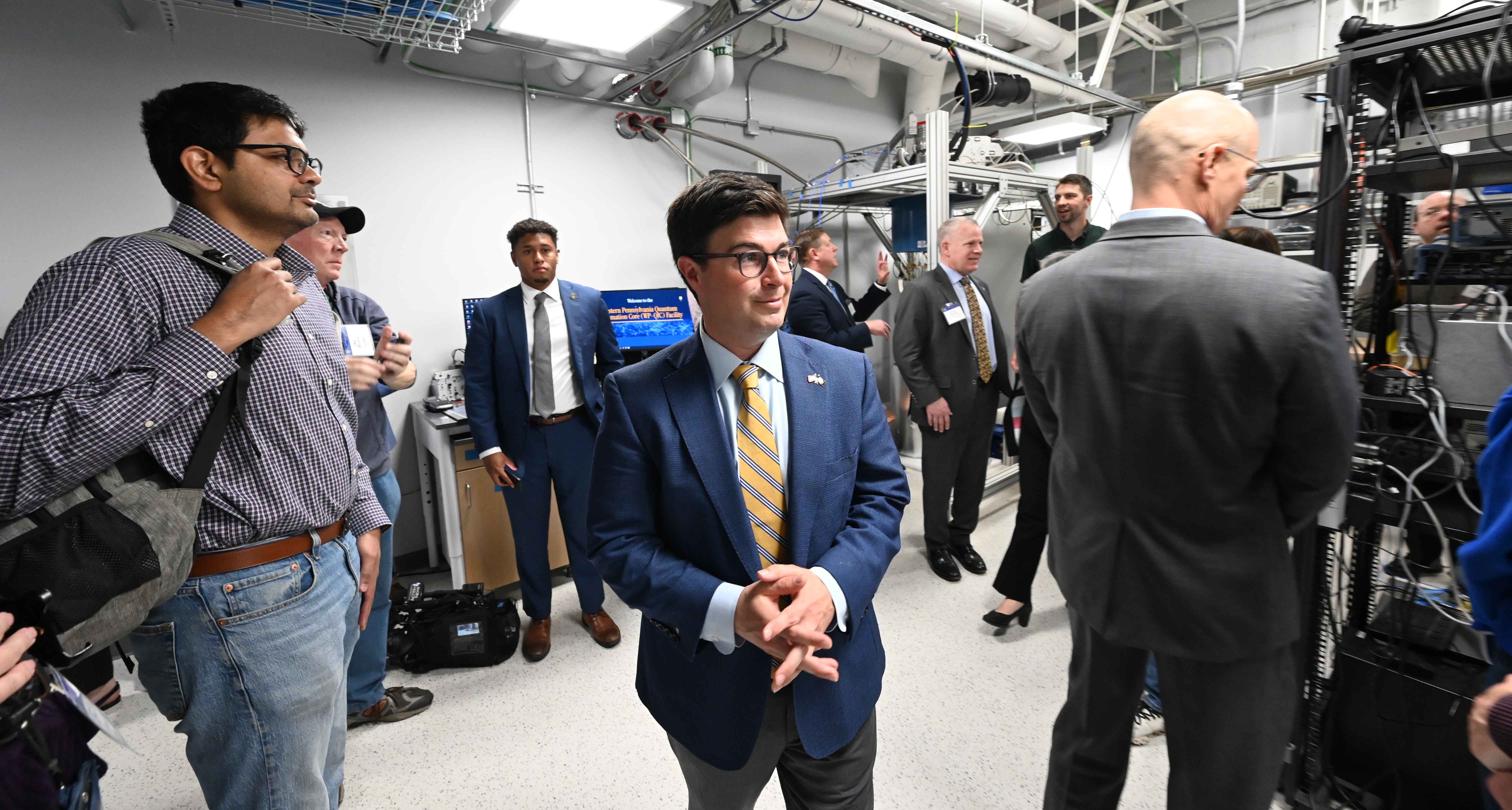
During his turn at the podium, O’Connor shifted gears from the high-level academic language that preceded him.
“I’m definitely not on your bingo card to talk about quantum physics, in case anybody was worried about that,” he said to hearty laughter. “… To have an institution like Pitt continuing to invest in the future, that’s why we are here and why we are so excited about this. This is how Pittsburgh is going to continue to grow.”
The plethora of experts in rapidly growing technological fields, the physical manifestation of a quantum lab and a substantial capital investment “means that Pittsburgh is going to grow,” O’Connor noted. “We have the talent here. It is our job to capitalize on that. And that’s why, on behalf of the city of Pittsburgh, we are so thankful for all of the deans and the amazing work that they do, and for the chancellor for continuing to step up.”
“This means a win for all of us in the city of Pittsburgh … because it means so much for us to have Pitt here,” he said. “And as a Duquesne alum, I wore my blue and gold. I am proud today to say, ‘Hail to Pitt!’”
Shannon O. Wells is a writer for the University Times. Reach him at shannonw@pitt.edu.
Have a story idea or news to share? Share it with the University Times.
Follow the University Times on Facebook.