
By MARTY LEVINE
Pascale Laborier hopes that a new exhibit on the ground floor of Hillman Library helps the University community “understand what it means to be an academic scholar at risk and also gives some dignity to our exiled colleagues.”
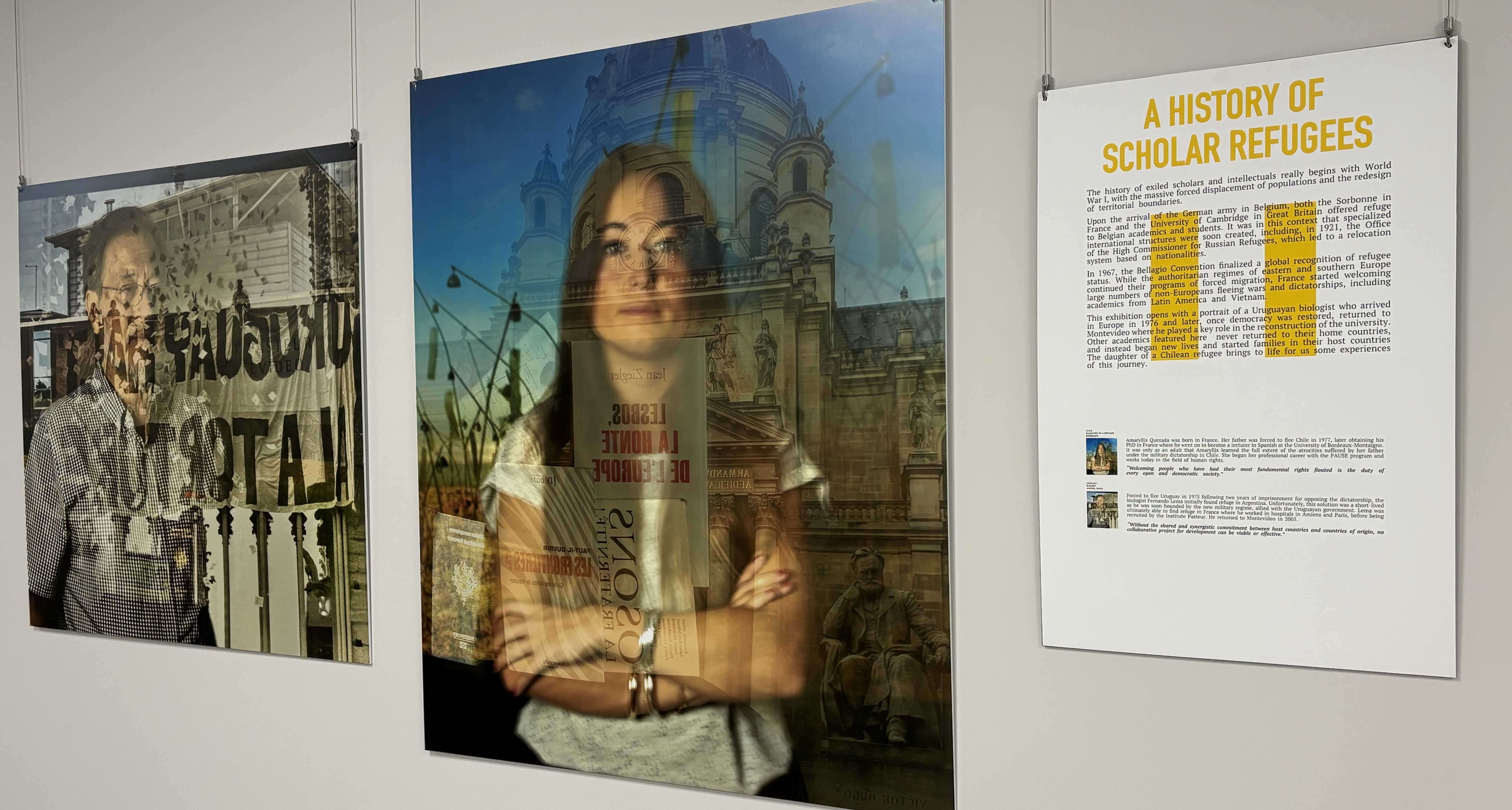
The exhibit, “Standing for Freedom: Portraits of Scholars in Exile,” was created and is curated by Laborier, a political science faculty member at the University of Paris Nanterre, in collaboration with photographer Pierre-Jérôme Adjedj. These academics and artists who have had to leave their countries around the world are portrayed with significant objects representing their exiles, images of the places they were forced to leave, as well as items that represent their scholarship and their hopes for the future.
When Laborier started France’s national emergency assistance program for scholars at risk (PAUSE) while serving as advisor to the country’s secretary of state for higher education and research (2015-2017), she discovered: “Most of my colleagues didn’t understand what it means to be a scholar at risk.” Their stories of “resistance and hope,” as she termed it in a talk that opened the exhibit here on Oct. 2, have since become the subject of her academic research.
Scholars often have a special place in society, Laborier says, but not when they are fleeing dictatorships. There may be a short mobilization to help them during the immediate crisis, “but afterwards nobody cares about them, because they are no longer at risk,” she adds. “But they are colleagues, so they should be in our world. Our purpose is to show a universal story of the scholar at risk.”
The exhibit also shows that exile does not define the worlds of these scholars, she says. They have long careers as academics, and this condition “is not a summary of what they are. With a picture you can tell the story and mobilize people about what has happened. Because of them we recognize our colleagues.”
The original photographs used images on glass — and sometimes through glass — to capture the scholars and their significant objects in one photo, originally displayed in a museum in France. “We want to tell the story with many facets,” Laborier explains.
Pitt’s exhibition is the project’s 28th stop, but given the difficulty of transporting the original glass images, the portraits in Hillman library are reproductions.
The exhibit includes a sociologist from Turkey, a historian from Iraq, a Venezuelan physicist, a political historian from Togo and many others. Some of them have needed to remain anonymous and partly hidden in their images.
The scholar from Togo was in France when police in Togo recognized him in a photograph among demonstrators for human rights. He knew that one of his colleagues in his home country was already in jail there, so he was forced to stay away. In his photo he is shown at the moment he decides not to hide himself from the photographer’s record. Laborier says he was thinking, “‘I have to testify for my other colleagues’ about political oppression in Togo, so that moment he took away his hand from his face. The picture is a moment between fear and (the choice to) make himself active.”
“Danger is never far away for researchers,” Gunn is quoted in the exhibit display. “Nobody chooses to become exiled for the fun of it.”
The exhibit includes other unforgettable images, such as a woman pharmacist with a photo of her home destroyed in Syria. When the exhibit appeared in Brussels, Belgium, it included a theater piece created from some of the scholars’ testimony. In Aachen, Germany, the exhibit was accompanied by a refugee orchestra playing music from different countries.
Laborier last year connected with Pitt during a French-American summit in Washington, D.C., meeting Sergey Frolov, professor in Pitt’s Physics and Astronomy Department, and discussed how to help Ukrainian scholars. After Dec. 19, when the exhibit ends (or after it is extended through the spring, as hoped), the portraits will be hung permanently in Frolov’s department in Allen Hall.
Laborier has also created a website in English, French and Spanish, Géo-récits (Geo-narratives), that displays in map form the complex, dangerous, world-spanning journeys of academics and artists forced into exile and seeking not only refuge but a place to continue their work. There are 200 stories of such scholars there.
Seeing this exhibit, Laborier says, and learning briefly about the emergency that exiled each scholar, “we should ask: What happens after that? What does it mean to be a scholar in exile?”
She has seen the exhibit’s effect in various places, as viewers are inspired to create funds to help the scholars, and as it connects exiles with organizations and individuals who can help.
As Laborier wrote in the exhibition program: “The restriction of academic freedom is a harbinger of democracies in peril. … Many exiles express their willingness to testify about what they have suffered and seen in their own countries. Their participation in this project resembles an act of resistance and solidarity for colleagues still trapped in their countries.”
Marty Levine is a staff writer for the University Times. Reach him at martyl@pitt.edu or 412-758-4859.
Have a story idea or news to share? Share it with the University Times.