
By SHANNON O. WELLS
When it comes to developing BioForge’s unique mission, Kaigham “Ken” Gabriel, the manufacturing center’s inaugural chief executive officer, admitted to deriving inspiration from negative emotional energy.
“I get frustrated and angry when I read articles about some child or some adult getting a new type of cell treatment, or precision treatment, and they can hear their parents’ voice for the first time — or the reversal of their cancer — and it sounds very promising and exciting,” he said. “But then a little bit later, you read that that treatment cost $2 million or $3 million, and (sentiments like) ‘Someday, we’ll get there.’
“The reality is, we’re not going to get there unless we work on it directly and deliberately.”
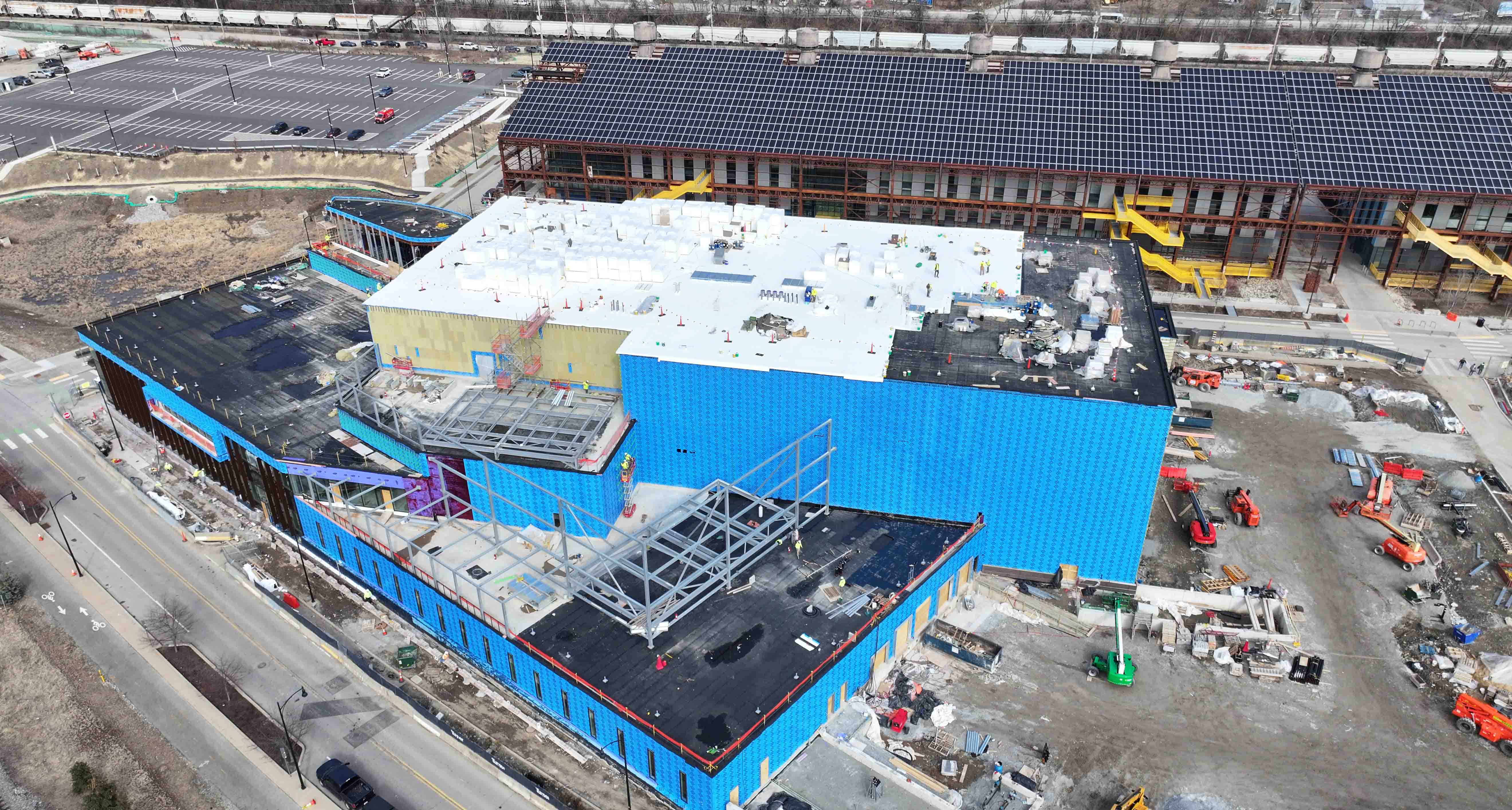
He also makes it clear what BioForge, the $250 million facility now under construction at Pittsburgh’s Hazelwood Green commerce park, will not be doing.
“We are focusing on creating breakthroughs and innovations in the manufacturing of precision biological medicines, period,” he emphasized. “What’s really important about that is we’re not developing new precision biological medicines. We’re not doing discovery-driven research in those areas.
“Because, frankly, (Pitt has) an amazing set of schools of Health Sciences doing that already.”
The gap BioForge intends to fill, rather, involves taking a select number of the discovery-driven research innovations coming from Pitt and saying, “which of these have broad potential for broad impact (and) are being held back from the broad impact because of manufacturing constraints?
“You’re not able to make them at a cost or quality or repeatability that allows you to make it affordable and accessible to all,” he said.
Gabriel, an internationally recognized engineering and life sciences entrepreneur and innovator who came to Pitt in late 2023, shared updates and insights with the University Times regarding BioForge and its short- and long-range ambitions.
Serving as BioForge’s CEO as well as founding director of its Advanced Biomanufacturing Institute (ABI), Gabriel is overseeing design, construction and operations of the Hazelwood Green manufacturing center and collaborating with national and international stakeholders to realize the BioForge vision.
In leading ABI, Gabriel works with academic, clinical, governmental and commercial partners to help develop Pittsburgh as a destination for advancing biomanufacturing technologies and processes.
Along with biomedical research at Pitt Health Sciences, the BioForge mission — to accelerate breakthroughs leading to delivery of new biologic, precision medicines to patients and the marketplace — is enhanced by the University’s partnerships with UPMC and the Hazelwood community.
Off to the races
Although the 185,000-gross-square-foot facility may not be ready for move-in until 2028, for all practical purposes, BioForge is already up and running. The fledgling staff operates out of the Riviera Building on Second Avenue next to the Bridgeside Point II development near the Hot Metal Bridge.
“It’s not as fancy as it sounds, and it is some really good space for us in this interim for the next two to three years,” Gabriel explained. “We weren’t going to just stand around waiting for the building to be done before we get the work done.”
In its first year of operations, BioForge has launched three projects, with another two in development that are set to kick off in the next two to three months.
With the core and shell of the Hazelwood Green building nearly complete, remaining work is mostly focused on the facility’s interior. BioForge’s pioneer tenant, the Cambridge, Mass.-based biotech company ElevateBio, is beginning to fill out its approximate 70% share of the building.
“It’s an extremely complicated fit out, because they’re building these state-of-the-art clean rooms,” said Kinsey Casey, BioForge’s chief administrative officer. “They have to go through the commissioning process with the FDA (Food and Drug Administration), because they manufacture things that actually go in humans.
“So, they anticipate starting manufacturing in that facility in the first half of 2027.”
The timeline for the remaining 30% of the building dedicated to BioForge remains somewhat uncertain, she added, because of how reductions in federal funding may affect the University’s capital budget process.
“They’re looking at it holistically, and that includes current projects, including ours, so it’s a little unclear what the timeline is,” Casey said, noting that more should be known by this fall. “They wanted to wait to see (if) there’s anything else that happens with the federal government.”
“We may be looking at moving in there sometime in the spring of 2028.”
Leaps of faith
Gabriel said he’s confident that BioForge’s collective skill set will be effective in addressing manufacturing- and cost-based obstacles to precision-medicine breakthroughs.
“The ‘what’ of BioForge is this focus on creating breakthroughs and innovations in the manufacturing (stage),” he said. “If we find things that are broadly impactful that are being held back by manufacturing, and we have potential solutions to that, then we bring those in as projects.”
“We are very clear about our mission on trying to address this issue of ‘How do we scale these discovery-driven results so that it can become affordable and accessible to the people who need it?’ ” he added.
When explaining the distinction that BioForge is not really in the manufacturing business, Gabriel admitted that some people’s “heads explode.”
“We’re going to create the breakthroughs and innovations, and we’re going to show how it’s possible to, say, reduce the cost by 100x or improve the repeatability and quality by 10x,” he said. “But once we demonstrate that … that’s when it’s time to either spin that innovation out, license it, whatever it takes for what we believe are the better entities that do the scaling — and that’s the private sector.”
As enthused as Gabriel is about BioForge’s potential and reach, he’s also clear there is no one-size-fits-all approach nor an expectation that every project will be a runaway success.
“A BioForge project has to be something where it’s broadly applicable, it’s being held back by manufacturing, and there isn’t a solution for it, but we think we know how to do it,” he said. “And it’s a risk.”
“This is not something that’s formulaic, that I insist on happening. … In my experience, in practicing this, if you do this right, 15% to 20% of the projects don’t get there. It turns out to be too hard,” he added.
“You can’t get the advances that you need for all sorts of reasons. And that’s OK. But that’s not going to stop us from taking a swing at it.”
‘Itch and a drive’
Potential projects come through a combination of entities approaching BioForge and the Pitt collaborative’s efforts in seeking them out.
“I spend a fair amount of my time talking to people throughout the University community — different departments, different entities, different centers — about what the mission is at BioForge, and how we go about doing it,” he said. “If that sounds like a good fit for something that they’re trying to do, either as individual faculty or departments or schools, that’s when we get input from them. And we follow up, and we start seeing if there’s a project there.
“The other direction, we often will find out about projects going on somewhere that people who know our model — now increasingly more of them — will say, ‘You should go take a look at so and so.’ And that’s the way we do it.”
BioForge is not geared, however, toward putting out open calls for projects.
“I want people to, first of all, recognize this is not a typical way to get funding for something,” Gabriel said. “(BioForge) is when you’ve got a project, you have a vision and an itch and a drive to make this happen, and you’re looking for not only support — that we do resource these projects at BioForge — but support and expertise that you don’t have anywhere else, and an approach that helps you achieve that success.
“It maximizes the likelihood of that success,” he added. “That’s the way we will continue to solicit and get projects in.”
CURRENT BIOFORGE PROJECTS
Here is a rundown of some initial BioForge projects:
RNA delivery: Gabriel describes the first project launched by BioForge as a business-model innovation in “creating a brokerage that enables people — users, designers, students, whatever” — to get access to manufacturing ribonucleic acid, or RNA, a crucial nucleic acid molecule that carries and expresses genetic information.
The intermediary-based concept creates what he calls a “two-sided marketplace” where manufacturers get access to potential customers far more efficiently. “Because the brokerage introduces standard processes for manufacturers on one side of the marketplace, and users get access in a standard pricing model so not every order has a bespoke manufacturing process behind it.”
“We are into our second year of doing that and are getting recognition and ready to step up that activity in the coming year,” he added. “It’s a bit of a new way for people in the life sciences to get these materials. … We have people at the Center for Vaccine Research at Pitt using it, and others.”
Precision skin cancer treatment: A project from Pitt’s Department of Dermatology is based on creating dissolvable micro-needle arrays, “which is a little bit tricky,” to deliver treatment for skin cancer — or potentially even a vaccine — at the most effective depth.
“A company that had a startup built around the technology had been struggling for a number of years prior with getting solutions to the volume and cost targets of these micro-needle arrays,” Gabriel explained.
The 10-month project will be the first at BioForge to “graduate, if you will, or exit the project” at the beginning of October based on a fixed-duration, fixed-budget arrangement. “The company allocated initially two full-time people to be residents … right next to us at BioForge, and now they’ve hired another two …
“They’re taking the solution we’ve come up with to the volume and the cost, and now actively looking for space to set up a prototyping facility in Pittsburgh.”
Adeno-associated viruses: This involves a class of viruses that are harmless to humans, but “really good at delivering genetic material,” Gabriel said. “The challenge is, how do you get the genetic material you want delivered inside the virus?”
The once “very promising” delivery mechanism for genetic treatment became somewhat sidelined, he noted, because of a “very complicated manufacturing process.”
Calling it a “really good, canonical example” of a BioForge project, he said there are “a lot of big challenges/steps in the manufacturing process that we have to completely rethink and come up with new solutions to. But if we’re able to do it, it would radically change the viability of this approach and maybe bring it back to be a contender.”
Peptides in cancer treatment: Anantha Shekhar, senior vice chancellor for the health sciences and dean of the School of Medicine, is leading a project in which a cocktail of about 20 peptides — essentially short proteins — are used as treatments for cancer.
“We’re bringing partners in from the University of Tubingen who have demonstrated the viability of this in Germany over the last 15 years,” Gabriel said. “Our work would be to transition the peptide manufacturing from Germany to here to support clinical trials kicked off by the School of Medicine. That’s going to be finalized over the next couple of months.
Shannon O. Wells is a writer for the University Times. Reach him at shannonw@pitt.edu.
Have a story idea or news to share? Share it with the University Times.