
By SHANNON O. WELLS
In most cases, a book tracing the life of a world champion Formula One racer would primarily attract readers drawn to fast-moving machines and the daring drivers who pilot them.
Lewis Hamilton is not like most cases.
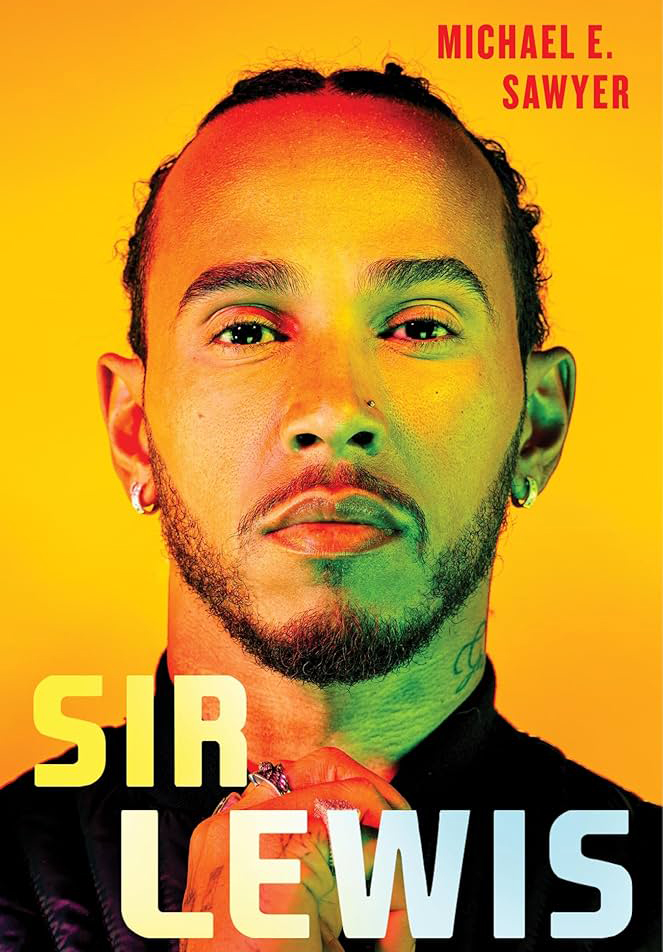 As Pitt’s Michael Sawyer — whose latest book, “Sir Lewis,” profiles the multifaceted life-in-progress of the British racer and Black activist — explained, Hamilton has much more on his mind than the finish line.
“I think when you talk about fans of Formula One, you’re talking about a kind of discrete set of people, but then when you add fans of Lewis Hamilton, you pick up a lot of other people,” observed Sawyer, associate professor of African American Literature & Culture and director of graduate studies for the Department of English.
That includes followers of everything from global fashion trends to environmental activism and — perhaps most notably to Sawyer — social justice.
“He’s one of the chairs of the (Metropolitan Museum of Art) Gala this year, so in the fashion world he’s really important … and I think people who are interested in social justice will find an important story to be told by someone who has had every possible (reason) to not pay attention to all the stuff that was going on with other people’s lives, but still found himself to be concerned with the death of Breonna Taylor in Kentucky,” Sawyer said of the Black medical worker killed by Louisville police officers in 2020. “And he’s a person from outside of London, England, so he’s concerned about the world in that way.”
Sawyer added that Hamilton, who received his British knighthood in 2021, is “a big advocate of gender equality, trans rights, the LGBTQ-plus community. All these things are important to him.”
Published by the Hachette Book Group and released in early March, “Sir Lewis” follows Hamilton’s journey from remote-controlled car hobbyist and to seven-time world champion and global superstar, which Hatchette calls “the stuff of sporting legend.” Sawyer’s biography follows Hamilton’s path from his early days go-karting on local tracks to — with the strong encouragement and sacrifices of his father — the “glitz and pressure of the Formula One circuit.”
Sawyer’s book tracks Hamilton’s determination to reach the top of the Formula One field while challenging racial barriers and opposition “at every turn,” highlighting the racer’s pioneering role in making motorsports more accessible to marginalized communities.
Examining Hamilton’s legacy, the book culminates with Hamilton’s potential final act: chasing a record-setting eighth world title at the wheel of the iconic Ferrari team.
While Sawyer, who joined Pitt’s faculty in 2021, considers the potential audience for “Sir Lewis,” as “diverse as it can possibly be,” that also makes it a “difficult” book in some ways.
“You have Formula One people who are like, ‘What am I reading about environmental concerns for?’ Or you have people who (identify with) environmental concerns or what he does in fashion who are like, ‘I don’t know the first thing about Formula One racing. Why am I reading about some (supposedly important) race that happened in 2009?’ So, you try to thread the needle — and you can’t make everybody happy.”
For this, his third published book, Sawyer simply followed his longtime love of Formula One racing. He traces this passion to the early 1990s, when he was in the U.S. Navy and stationed at Naples, Italy.
“That was when I really became interested in the sport, just because it’s such an immersive opportunity to see your first one in Italy. It’s kind of like going to the opera the first time at La Scala (in Milan). … The sport is kind of right there,” he said. “So I followed it throughout my career in the Navy.
“Then when I worked in finance, I would try to figure out a way to get to see races,” the Colorado College graduate said of his Wall Street years. “So, I’ve always been interested.”
It was around 2006 when Sawyer started hearing about Hamilton, who was coming up through the junior ranks of open-field racing.
“It was interesting story, not just because people were talking about competitiveness and his skill level, but also the fact that he was the first black person to ever be at that level in the sport,” Sawyer said. “So when he finally showed up in 2007, I followed it really closely at that point, and I’ve been following his career ever since.”
 Around 2015, Sawyer said he went back to his notes and started thinking about a book title, “and started making some notes and watching what was going on.”
A few years later, Sawyer said Hamilton started taking some “dramatic and important stances” on issues of social justice, environmental justice, and what’s become commonly known as diversity, equity, inclusion, or DEI.
“At that point, I was like, ‘This is a person who’s worth taking a closer look at beyond sports,’ ” he said, noting he’s not a sportswriter, per se. “I love sports. I was an athlete in college myself. But that doesn’t mean that I want to write a book just strictly on an athlete’s career.”
Given many racers’ typically myopic focus on matters of the track, namely speed and safety, Sawyer said they’re not necessarily the “most interesting people in the world, from a perspective of writing a book or story about them, because they drive fast cars and that’s what their lives are pointed towards.”
Hamilton, however, “has all these other interests” outside of Formula One that “make him unique in the world of sports” from multiple perspectives. Sawyer also qualifies the notion that “Sir Lewis” is a traditional biography.
“Because, obviously, he’s still in the middle of his career. But it was an opportunity to take stock of everything that had come before,” he said of the 40-year-old racer. “And it basically situates us to watch these last few years of his career.
“And I think it puts us in a good position to kind of absorb (and evaluate) what happens with this last campaign in his racing career.”
Acknowledging that Hamilton may be an obscure figure to some, Sawyer said in the book he provided “on ramps” to people who don’t know much about Formula One racing, explaining the rules and what transpires in races.
“Part of the ambition was so people would both understand Lewis Hamilton as a kind of athlete, cultural icon and social justice advocate, and also be able to understand the sport that I care a great deal about and think people should pay attention to.”
In Sawyer’s estimation, Hamilton, who at the Australian Grand Prix in 2007 became the first Black driver to compete in Formula One, provides a real-time example of a DEI-oriented philosophy and mission transforming struggle to success.
“If a person wants to refute arguments against diversity, equity and inclusion, I use Lewis Hamilton as an example,” he said. “Because if his first team, McLaren, hadn’t gone through the trouble to support a driver from a non-traditional, underrepresented background, we would not have had the greatest Formula One driver in the history of the world.
“It’s not a question of lowering expectations, it’s a question of raising them,” he said. “It’s that audience I think that’s important. If you’re interested in kind of global culture — because Lewis is kind of a global tastemaker, an icon in fashion, music, sports ownership, etc. — he’s in all these kinds of interesting places.”
Shannon O. Wells is a writer for the University Times. Reach him at shannonw@pitt.edu.
Have a story idea or news to share? Share it with the University Times.