
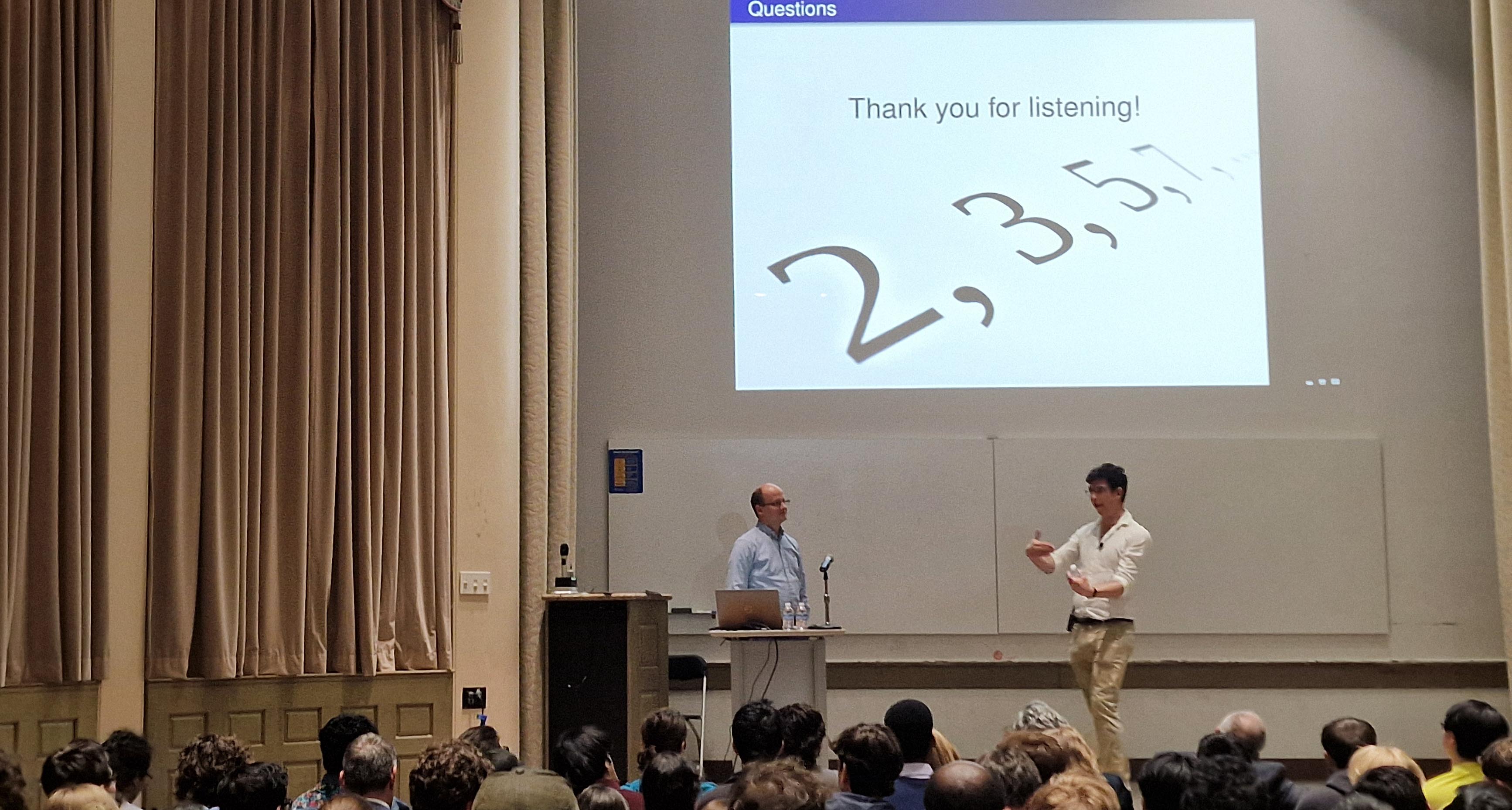
Fields Medalist James A. Maynard visited Pittsburgh in March as the featured speaker for the inaugural Pittsburgh Mathematical Horizons lecture series — a new annual event made possible through the support of the Benter Foundation.
The visit kicked off March 20 with a Joint Mathematical Colloquium on the Carnegie Mellon University campus, hosted by Pitt and CMU, tailored for a mathematically inclined audience. The event attracted more than 200 attendees. The Fields Medal, which is given to two to four mathematicians 40 and under every four year, is widely regarded as equivalent in prestige to winning a Nobel Prize.
In his colloquium lecture, titled “Primes and the Riemann Hypothesis,” Oxford-based Maynard provided an introduction to one of mathematics’ most celebrated problems — the Riemann Hypothesis. He explained that while the hypothesis is often hailed as “the most important unsolved problem in mathematics,” many of its implications for the distribution of prime numbers can be approached even if counterexamples exist, provided they are rare.
He also showcased recent collaborative work with Larry Guth that has enhanced understanding of these exceptions and deepened insight into prime distribution.
On March 21, Maynard addressed a broader audience at the inaugural Pittsburgh Mathematical Horizons Lecture, held in the Frick Fine Arts Building. The lecture hall’s capacity was again exceeded by the more than 200 audience members — many of them non-mathematicians, including undergraduates, high school students, and several senior community members.
Maynard was introduced by Dietrich School of Arts & Sciences Dean Adam Leibovich and Carl Wang-Erickson, Pitt assistant professor of mathematics. Maynard tackled the enduring question, “How often do two prime numbers differ by exactly 2?” — what is known as the twin prime conjecture. He highlighted how seemingly simple queries about prime numbers are deeply intertwined with real-world applications, such as the security of internet communications, illustrating the connections between pure mathematics and practical technology.
A common theme across both presentations was the recognition that, while we still lack the complete techniques to resolve fundamental questions like the Riemann Hypothesis and the twin prime conjecture, the last two decades have seen exciting progress in chipping away at these obstacles. Notably, Maynard’s own groundbreaking contributions have played a pivotal role in advancing the field — efforts that were recognized with the awarding of the Fields Medal.
Beyond the formal sessions, Maynard took the time to interact with graduate students and postdocs over lunches and dinner.
The two-day event, as envisioned by the organizers from the Department of Mathematics, not only showcased groundbreaking modern mathematics but also served multiple purposes helped inspire junior mathematicians and engaged the broader public in the topic.
— Adapted from the Department of Mathematics, Dietrich School of Arts & Sciences