
By SUSAN JONES
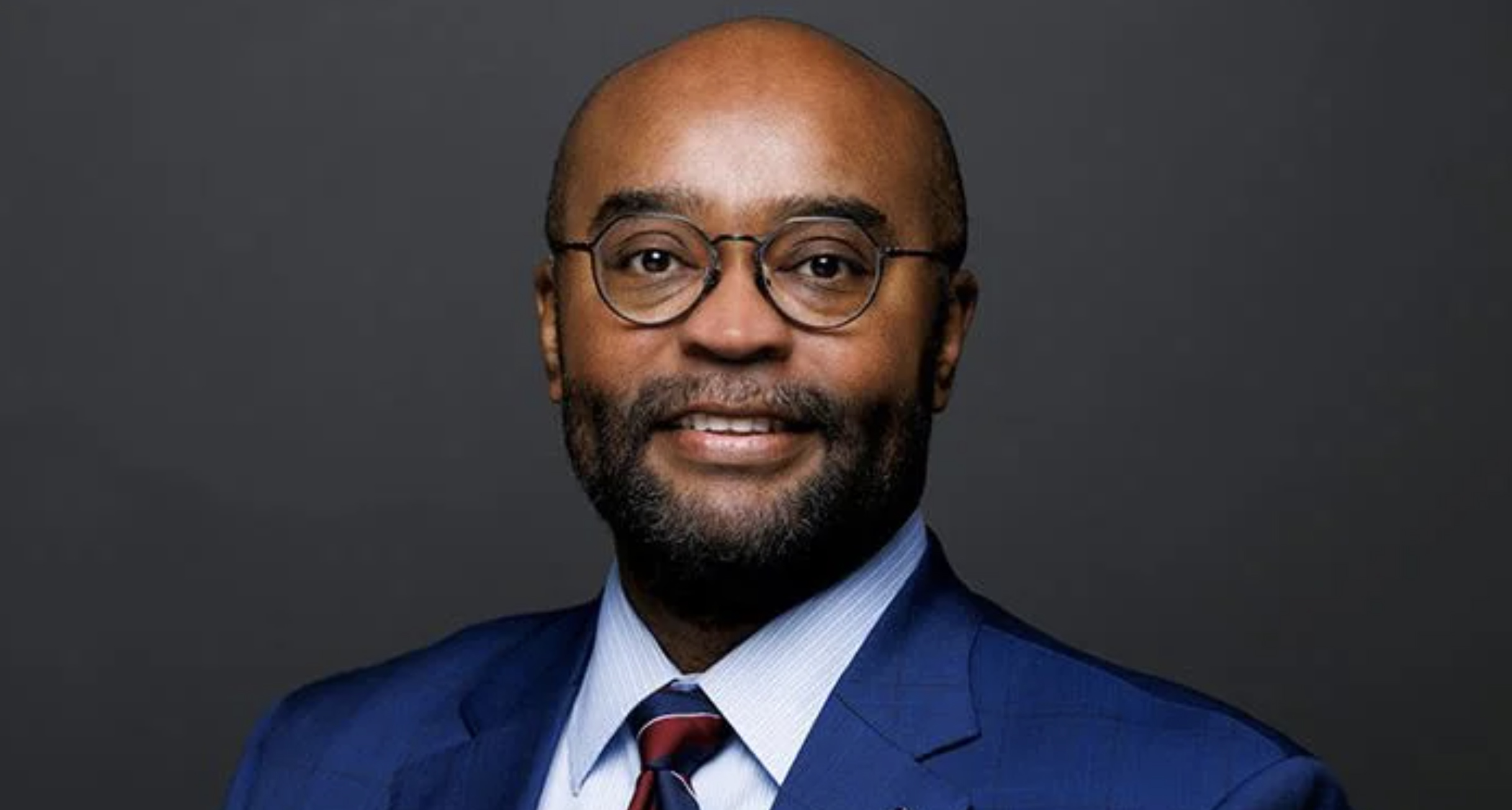
Taking a job at Pitt brings Dwayne Pinkney’s career full circle.
The new executive senior vice chancellor for administration and finance and chief financial officer got a master’s degree in public administration from Pitt’s Graduate School of Public and International Affairs in 1987.
“So much of what has happened for me in my career started here at Pitt,” he said in an interview this week. “The preparation that I received here at the Graduate School of Public and International Affairs just really set a framework in a very foundational way for me that I have been able to leverage throughout my career.
“I never imagined that I’d have this opportunity to come back to the place where that professional journey began and to make this contribution in this way,” he added.
He also was interested in coming to Pitt because, “while it is doing all of these amazing things within higher ed — it’s not a secret, so I don’t mean to suggest that — but there is very little hubris associated with this University. There’s a lot of humility with a great deal of impact.”
Another factor in his decision to join Pitt’s senior administrative team was Chancellor Joan Gabel’s leadership and vision, “which are known entities within higher ed,” he said.
Pinkney joins Pitt as the first person to hold the combined position over the Offices of the Chief Financial Officer and Business and Operations. He also was the inaugural executive vice president for finance and administration at Indiana University, where he had been since March 2022.
Prior to that role, he worked at Virginia Tech for nearly four years as the senior vice president and chief business officer, and at the University of North Carolina at Chapel Hill (where he got a Ph.D. in political science) for eight years, ending as the chief financial officer and senior associate vice chancellor for finance and administration.
He began his career in the North Carolina General Assembly as an analyst and served as the deputy secretary for administration with the North Carolina Secretary of State’s office. He also has a bachelor’s degree in English and journalism from North Carolina A&T State University.
Pinkney met with the University Times this week for a wide-ranging interview. Responses are edited for clarity and length.
UTimes: Why is it important to have the CFO and Business & Operations positions combined?
Pinkney: I would say the trend is for there to be greater collaboration, coordination, and in many cases, integration of … finance and administration. That’s not necessarily a new thing, but I think what is new is the recognition that it’s not enough for the individuals leading the respective functions and the teams that support them to be good at what they do, but where the real impact happens is when there is unity of effort among those administrative and support functions, and it’s clear that the individuals and the groups doing that work can and do show up as an enterprise.
Because whether it’s when faculty members experience something that is less than ideal from the administrative and support functions, or whether students and parents experience gaps, they typically don’t think about who specifically is responsible for that thing — well, that’s a procurement issue or that’s payroll. It’s administration. And so to the extent that the individuals and the teams that have responsibility for those functions are collaborating, working together and making sure that the experience looks, feels and is seamless for constituents, that’s where the real impact is.
That’s the work I’ve been engaged since my time at Virginia Tech. I stepped into an inaugural role where those functional areas were reporting through vice presidents, directly to the president, and the president said to me, ‘I really want this to be a team.’ … That was the work we engaged in, and we did that in relative short order at an institution that had at least for 10 years been operating without someone in that kind of role.
UTimes: How is what you oversee here at Pitt comparable to what you were doing at Virginia Tech and Indiana?
Pinkney: It’s not necessarily one for one, but it is certainly comparable. Finance and facilities oftentimes are two of the areas that touch so many individuals at an institution, so having those two in the portfolio has been the case in my roles.
What I’ve said to every president or chancellor with whom I have a conversation — whether it’s in an advisory capacity or performing the function — that for me and the way that I work with my colleagues, it’s less about who reports to whom than it is about how these individuals and teams work together.
Organization can facilitate that. If you have the functions in the same organization, it’s in some ways a shortcut and can make it a little bit easier. But it’s not necessarily sufficient just to have everyone in the same organization. It still requires attention and effort to make sure that the teams and constituents are working together in a way that you really are moving in the same direction. You don’t get to, just because of organizational structure, push a button and think that everything is going to work the way that it should.
UTimes: Is there a duplication of effort now in any place that you need to examine?
Pinkney: I’ll obviously be looking very carefully, and I have been looking. This is week five. I don’t want to be knee jerk in any changes we might pursue. And it does take time, because what might appear to be duplication at first glance can be resilience. You want to be very careful about making sure you retain capacity.
Oftentimes, when you’re working with these functional areas, you see that there are individuals who have performed in ways that I will characterize as ‘heroically’ over time, and that’s a wonderful thing to have, but what that can mask is sometimes there is not as much resilience within functional areas. As heroes leave the stage, you discover that the bench is not very deep. So before I make a decision about whether we have what I’ll call true duplication, I’ll want and need the opportunity to really adequately assess just how deep the bench is and how resilient we are in these functional areas.
UTimes: What do you see as the biggest opportunities in the areas you’re overseeing here at Pitt?
Pinkney: We’ve been talking about what I think are some of the more immediate opportunities, and that really is just just building a sense of unified identity among the areas. And you don’t just wave a wand and make that happen. You have to build that. That is, at least from my perspective, a first order of business to do that.
Specific things like Budget ReSTART (Pitt’s new responsibility-center based budget model) are opportunities that we certainly will more than explore, but look to improve. I was talking about how with organizations, you can’t just push the button and assume that, OK, now you got it, it runs impeccably forever.
The same with budget models or any other process that you might design. These support systems and processes and budget allocation schemes are designed to support the strategic direction of the institution. You can’t change them wildly from year to year, but you have the opportunity, and I think responsibility, to evaluate them constantly, to make sure that you are, in fact, supporting the strategic direction of the institution.
I suspect that Pitt has learned a lot with Budget ReSTART. And then the challenge becomes, what do you do with what you’ve learned? With the mechanisms that you have, do they require tweaking, adjustment, something that is perhaps more significant than that, to make sure that you’re maintaining that alignment between the way you allocate resources and the incentives that you intend to establish. Is that working the way that you intended, and whether you’re positioned to get the outcomes that are reflected in the Plan for Pitt. So that’s an opportunity, and I will definitely be excited to lead that work around Budget ReSTART. Full disclosure in week five that I don’t have all of the mechanics of the Budget ReSTART committed to memory.
Conceptually, what we’ve done here is in line with what is happening in other major research institutions, as you try to align resource allocation with strategic direction and create the incentives to fill your strategic missions. But I do think that, just based on the early feedback that I’ve heard in conversations with the provost’s office and with deans, that we have an opportunity to make adjustments and refinements … that will strengthen ReSTART, and I’m excited to engage that work.
UTimes: Is there anything else you’re hearing about the new budget model from the deans and others?
Pinkney: Well, the one thing that I think is pretty consistent is that, from the dean’s perspective, there needs to be more of a connection between the incentives that we intend to support and the resource allocation. And I don’t know to what extent there are gaps in that area, but that’s an observation I’ve heard — with not a lot of detail and really with no data. I mean, no one’s come to me and said, ‘Hey, Dwayne, this was my allocation, and here’s what I’m attempting to do. I’ve grown credit hours, or I’ve done more research and I’m trying to connect these dots.’ That’s the kind of data I’ll be wanting to see and understand better to evaluate the extent to which those connections are in place, and if they aren’t, what adjustments we can make so that becomes clearer.
UTimes: One of the things I’m hearing is about the cost per square foot the schools have to pay back to the central administration compared to what you can rent space for in Oakland on the open market.
Pinkney: Not an uncommon observation in higher ed space allocation and the cost for space or space renovations, that you can get a better price if you were to go on the market for those things. If you make those casual observations, sometimes you can find support for that. If you look a little deeper, oftentimes you find we’re not necessarily just transactional. When we stand up enterprises like facilities, it’s not to do just one transaction.
… If I wanted to paint in here, I could go out and get a better price, but that’s not what we’re trying to do as a university. We have to have sustainable enterprises, and that means that for the cost of doing this project and other projects, and being able to do them over a period of time, … we have to be able to support the business for the long term.
I might be able to extract a really good price here, but then next year, I’m unable to get anything done because there’s no capacity in the market; no one’s interested in doing work here, because things are booming. So we run the enterprises that we run because we’ve determined over a longer period of time that it makes sense for the institution to do that for the institution. When we do those comparisons, what I have found in many years of doing this is that you have to take a much broader and comprehensive view of what the institution is solving for.
There certainly is an opportunity here at Pitt to better understand our space utilization and the cost associated with that. What I have seen in other places is that when we understand that information better, that behaviors change.
I’ll give an example. When I was at Virginia Tech, we did not charge for space in our budget model, but … we showed deans and department heads the value of the space they occupy. And what we observed once we started to publicize those data, is the conversations changed around from ‘We don’t have enough space’ to ‘Well, you know, maybe I don’t need this space.’
And I don’t think there was anything at all cynical about the new way of thinking about things. I just think the headlights weren’t on. When you turn the headlights on, and individuals and departments can actually see their footprint and see the value of that footprint, they get an opportunity to be really strategic about how they use that space. And maybe they determine they need more, but what I did see was in some cases — and it wasn’t just a few units — they made the calculation that they could give up some space. That creates opportunities.
UTimes: You said you knew of Chancellor Gabel’s reputation in higher ed. Had your paths crossed before?
Pinkney: Not directly, but higher ed is relatively small, and so certainly I have known individuals who have had experience working with the chancellor, whether it’s by conference or professional associations. Folks talk, and they talk about who is building the kind of culture and leadership culture that’s attractive, and it’s in those circles that I have certainly heard about Chancellor Gabel. And I’ll say that the previous president that I supported at Indiana University and Chancellor Gabel know each other, and I actually was introduced to Chancellor Gabel by the president at Indiana University.
UTimes: The CFO’s office was probably the first adopter of sending people home and not bringing them back after the pandemic. The office is almost fully remote and it gave up office space. Is that something you’re comfortable with, or is it something you’re looking at?
Pinkney: I am looking, but I’m looking with this eye: When I think about our constituents and our partners to the extent that we are meeting their needs in the way that we’re operating today — and we’re operating in a hybrid environment — then I’m not dogmatic, and wouldn’t approach anything in a dogmatic way about how and where we work.
If hybrid work works for Pitt and works for the groups and individuals with whom we work, then I support hybrid work. If there is any diminution in our capacity to support our constituents, then we need to revisit. But it is about our ability to support the individuals and teams we need to support in the campus community, and not about a fixed idea about what’s appropriate — remote, hybrid or in person.
UTimes: What do you see as the biggest changes at Pitt since you were here in the 1980s?
Pinkney: At that time, the University and the city had already begun what folks refer to as the transformation, the renaissance, but it’s continued. The acceleration of the things that have made Pittsburgh and Pitt strong in the health sciences and the medical sciences has been impressive to watch from afar, and certainly something that I’m very pleased to now get to be a part of and to support.
This is not the first time I’ve visited Pittsburgh since graduating those many years ago, and I have obviously read about, seen and heard colleagues talk about Pittsburgh being a place that they would like to live, and just witnessing the changes in this city, the vibrancy of its neighborhoods.
Pittsburgh is one of those places — it’s got very good, positive buzz. And given where it is in the Northeast — oftentimes, you think about the places that have that kind of vibrancy, they’re in warm climates, with the exception of Boston, maybe a few others. But Pittsburgh is one of those exceptions. It’s not just about the weather, it’s about what’s happening in this city and in this region. I’m not surprised by it, but it is great to see that.
UTimes: Do you see yourself staying here long term?
Pinkney: Yeah, I do. I’ve been in higher ed for close to 25, years, and higher ed-adjacent for closer to 30. … So in roughly a 30-year career, I have changed higher ed institutions three times. When I left University of North Carolina to go to Virginia Tech, I had the opportunity to lead many of the functional areas that I had either led individually, or performed those roles. I had an opportunity to have all of those functional areas in one portfolio, and essentially to leverage the experience that I had kind of developed over a long career.
When I left Virginia Tech to go to Indiana University, I had a unique opportunity to go a little bit deeper in the finance area in ways that I could not in North Carolina or Virginia because of the way that finances are managed in those states. They’re things that I could do institutionally — investing operating funds — that you couldn’t do in North Carolina or Virginia.
The reasons that I walked through with you earlier about the proposition of coming to Pitt, I mean, this is in many ways full circle. And I’ve had the opportunity to expand and grow my portfolio, to really leverage my experience. All that is present here and more.
There’s really no ceiling to what I’m able to do here. That is not something that I took lightly in looking at this opportunity. And so for the reasons that we talked about earlier and the relative few times within my overall career I’ve made that change, I’m quite comfortable and quite confident that the University of Pittsburgh is a place that I can have the impact that my career has prepared me to have, and I’m really excited about the prospect of doing that work here.
Susan Jones is editor of the University Times. Reach her at suejones@pitt.edu or 724-244-4042.
Have a story idea or news to share? Share it with the University Times.