
By SHANNON O. WELLS
As far as Chad Taylor is concerned, the essence and importance of jazz music extends well beyond the more common conceptions associated with it.
“I’ll be in casual conversations, and someone will say, ‘Oh, I don’t like jazz.’ And my head always turns, because I don’t know if they actually know what they’re saying,” he said. “When I hear someone say they don’t like jazz, that’s like, ‘Oh, I don’t like breathing air. I don’t like air.’ Because jazz is a part of everything.”
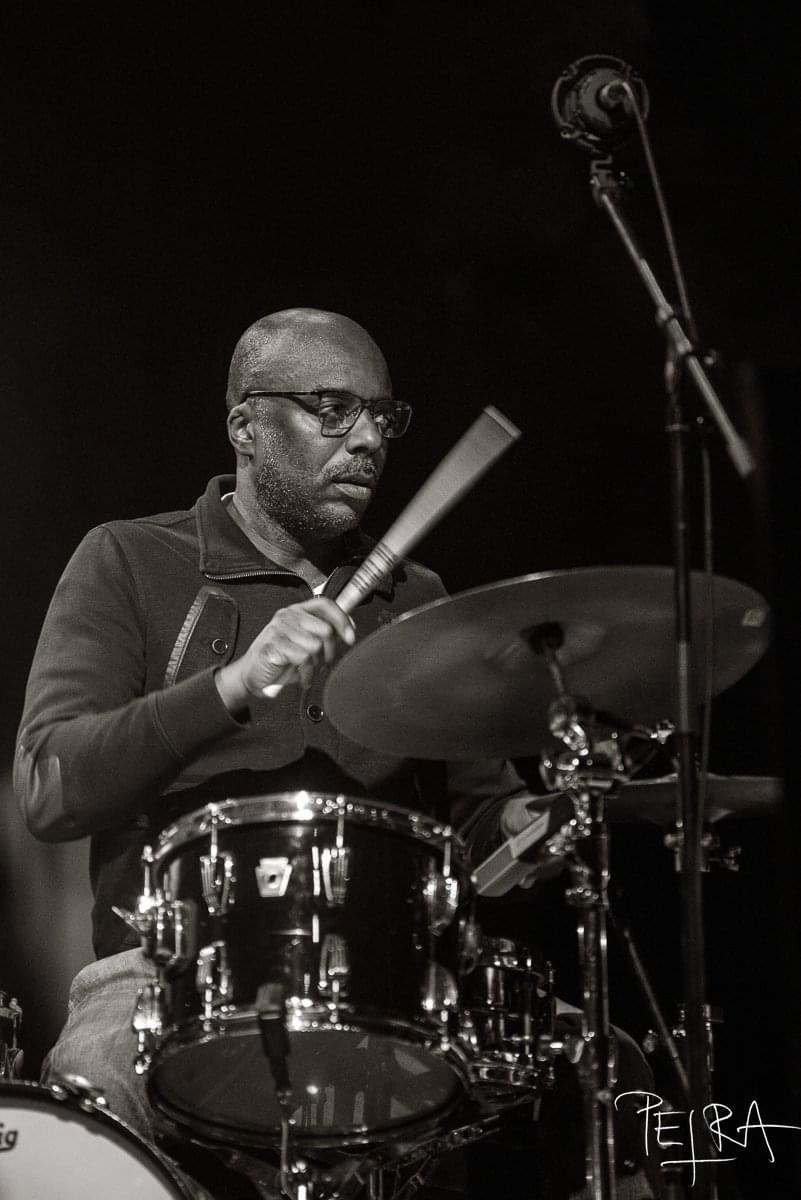 He cites the common “trap” drum set — a snare and an array of tom toms and cymbals anchored by a bass drum — as an example of jazz’s ubiquity.
“The drum set was an instrument that was developed to play jazz music. So any music you hear, and you hear a drum set, well that’s jazz. That comes from the jazz tradition,” Taylor added. “Jazz is in all sorts of American music that people listen to, whether you realize it or not.”
Taylor, a longtime drummer, composer and educator, intends to share his musical passion with as many others as possible in his new role as the fourth artistic director of Pitt’s Jazz Studies Program. Succeeding Nicole Mitchell, who left Pitt for a position at the University of Virginia in 2022, Taylor will be the second person to serve as the William S. Dietrich II Endowed Chair in Jazz Studies.
Taylor’s role includes directing the jazz program’s public programming and community outreach efforts, including the annual Jazz Seminar and Concert week in early November, teaching courses on jazz performance and scholarship, and working with other faculty to develop long-term visions for jazz studies programs at the undergraduate and graduate levels.
Taylor said he’s excited for an opportunity to become part of — and ultimately build on — what he considers a highly vibrant and respected academic program at Pitt. The ongoing popularity of the History of Jazz course is at least one indication to him that the form of music and expression is alive and quite well.
“There’s a big interest in jazz amongst non-music majors at Pitt, which is a beautiful thing,” he said. “I think that’s a huge strength. Also, the graduate program is world renowned. I mean, it’s an incredible program. It’s very small, but that’s what makes it great, because you have this small program of all these incredible resources with the different schools.”
Although, historically, jazz may be associated with late-night jams in smoky urban clubs, Taylor’s goal is to bring as much daylight to the music and its history as possible at the University.
“I want to engage with the entire school,” he said. “It’s not just about the jazz being in the jazz department. … I’m a believer that jazz has something for everybody. I want to engage with the students. I want to engage with the faculty, the different programs, and really make jazz accessible to everybody and get new fans and people interested in the music.”
‘Versatile and adventurous’
A Philadelphia native, Taylor, who’s been a touring drummer since his early teens, is no stranger to the Pittsburgh music scene.
“By the early ’90s, I remember Pittsburgh being part of the touring circuit. So I would perform gigs … usually more at rock clubs and DIY sorts of venues,” he said. “And then I stopped playing Pittsburgh for many years. I’m not sure why. It just wasn’t part of the circuit for a while.”
In more recent years, Taylor found himself returning to the Steel City to perform as part of City of Asylum, an artistic and creativity-nurturing community organization based on the North Side.
“That sort of gave me an opportunity to get to know Pittsburgh again,” he explained. “And then, when this opportunity came about to work with the University, I jumped at it. So many of my favorite jazz musicians come from Pittsburgh, and I’m extremely excited about working with the Pittsburgh jazz community.”
Aaron Johnson, chair of Pitt’s Department of Music and interim director of the Jazz Studies program, said he first heard of Taylor while performing “in the distant past in New York,” but didn’t really get know him until he applied for the Pitt position.
“Chad is an amazing, versatile and adventurous musician, and I expect Chad to bring that sense of wonder and discovery to students at Pitt and to our surrounding community,” Johnson said. “All of our music programs need to change to remain relevant, and jazz is no exception.”
Johnson said he looks forward to Taylor’s approach to presenting, programming and curating music that “helps all our students learn about how the world works,” while collaborating with Yoko Suzuki, the program’s teaching associate professor, to “improve our undergrad jazz major and minor education experience.”
Living and breathing asset
Johnson credits the success of the Jazz Studies program, which he called “among the oldest and … most innovative in the country,” to the devotion of Nathan Davis, who came to Pitt in 1969, “at a time when very few working, professional musicians taught jazz to undergrads. The program he created touched many areas.”
“At Pitt, we do not have a large body of conservatory focused music students, but Dr. Davis recognized that excellence and experience in jazz and improvised music was useful to undergrads in general — those in the jazz ensemble and to the hundreds of students taking the History of Jazz course,” he added. “And he brought graduate students to Pitt to conduct scholarly research in jazz.”
Johnson worked with the late Geri Allen, former director of Jazz Studies, and Michael Heller, former associate professor in the Department of Music, to create the only Jazz Studies doctorate program in the U.S. “Our Ph.D. requires demonstrated excellence in research and jazz performance. At other (schools), one might concentrate on jazz, but have to complete their degree in musicology or ethnomusicology, or outside of music in American studies or history.
“Pitt Jazz Studies has a long tradition, going back to its beginnings, of cherishing the rich history of jazz in Pittsburgh and of being a living and breathing asset to the Pittsburgh community,” he added.
That’s exactly the heritage and spirit Chad Taylor looks forward to tapping into, nurturing and elevating.
“For me, jazz is very much a living, breathing art form. It’s not something that … we look back at and say, ‘Oh, this is (what was played) in the old days,’ ” he said. “It’s very much alive and well.”
He’s particularly looking forward to the Jazz Seminar and Concert Week, which will include a celebration of renowned Pittsburgh drummer Roger Humphries, who just turned 80 years old.
“We’re going to have a mix of older musicians as well as some of the most celebrated and cutting-edge jazz musicians, such as Immanuel Wilkins,” Taylor said. “I’m so thrilled that he’s going to be part of the seminar this year as well, because jazz for me, it’s about a community of elders — as well as for everybody.”
That includes guitar players, which will be represented by Jeff Parker, who will offer his own seminar as well as DJ at another event. Details of this year’s seminar are still in the works, Taylor noted, “but that’s something that I’m hoping is going to bring a lot of people.”
One aspect Taylor hopes to drive home with such showcases and in his new role is that studying and playing jazz provides benefits and skill sets that go well beyond the world of music and entertainment.
“Part of it, I think, is just the improvisational aspect of it, because being able to improvise is a skill. And being creative, that’s a skill that is in not just music, but in any sort of successful business, like Apple or Google, or any of these big innovative companies,” he said.
“Being able to be creative and innovate is the secret to that success. And when you look at a great jazz concert, you see that happening, in real time, that this is an amazing art form.”
Shannon O. Wells is a writer for the University Times. Reach him at shannonw@pitt.edu.
Have a story idea or news to share? Share it with the University Times.