
By MARTY LEVINE
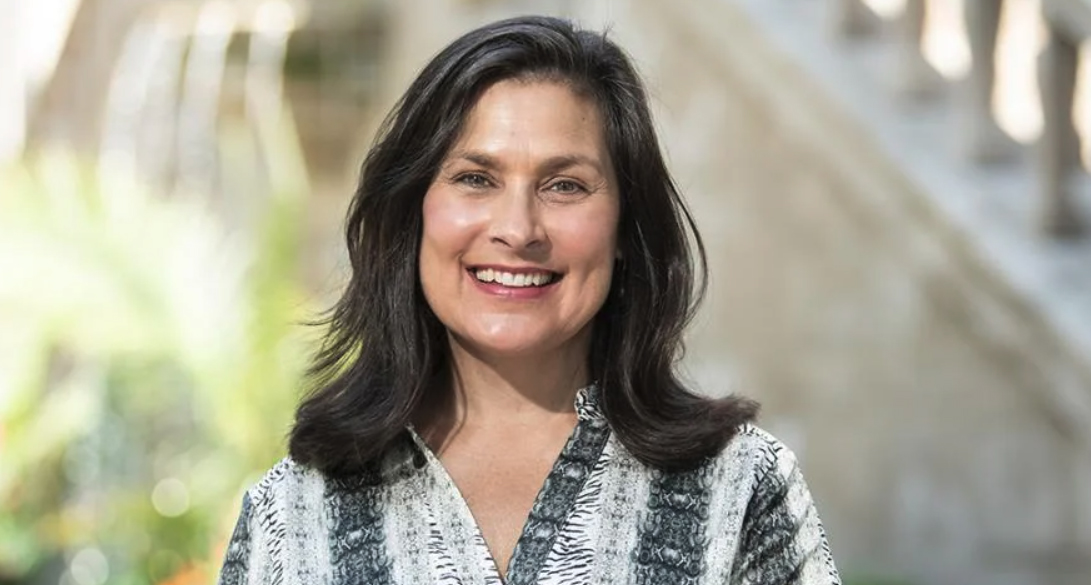
Decades of her life, including her family’s background and early experiences at Pitt, have shaped her career, Kati Csoman, director of the Nationality Rooms and intercultural exchange programs, told Staff Council’s Coffee and Conversation event on Aug. 1.
Her father came to Pittsburgh as the Soviets put down the 1956 Hungarian revolution, and his work with the Hungarian community here was an early inspiration, Csoman said.
COMING UP
The next Staff Council Coffee and Conversation will featured Rachel Richelieu, vice chancellor of University communications and marketing, at 10:30 a.m. Sept. 3 in the first-floor ballroom in Alumni Hall.
Find recordings of previous Coffee & Conversation events on the Staff Council website.
At Pitt, she had “an amazing mentor,” Csoman added, in Bob Donnorummo, then associate director of the Center for Russian and Eastern European Studies. He “encouraged me to apply for a scholarship through the Nationality Rooms’ intercultural exchange programs” — the very program she heads now. That sent her to Hungary, where she stayed in a small village. Later, she went to work for the American embassy in Budapest on a fellowship. She returned to Pitt for further study at the Graduate School of Public and International Affairs and also worked in the University Center for International Studies.
For the next two decades she was employed at Juniata College, in central Pennsylvania, culminating in the position of dean of international education.
“Even though it was a small school,” she said, “it was recognized for comprehensive internationalization. It’s the same award that Pitt has. … I was able to work in all areas of international exchange and international education but also (had) the opportunity to either lead student groups abroad or faculty groups abroad and travel to a lot of the world. That has helped me to develop truly an appreciation for different cultural approaches to work, different ways of being in the world…
When she applied for her current position, she said, everything about it — “working with community, working with scholarships” — fit her background perfectly. “The one area that I was not so experienced in was the museum work, but then I have a great team of people with whom I work — my colleagues who have that experience and who have those skills — and so we’re able to complement one another.
“Despite being a volunteer for about 15 years with the program — I was an officer of the Hungarian room committee and I participated in holiday open house — I didn’t realize the degree to which there would be so much work with the committees. … They really want to share the spaces. They want to share their intercultural backgrounds and so there’s a lot of work to help them to plan and to do things within the Pitt system.”
She was glad to return to Pittsburgh: “I love the vibe of the city, so that felt really fun to be back. My family is still here and so that was wonderful. In fact, I was able to spend the last few years with my dad, who passed away two summers ago, and so that felt really right as well.”
Asked how new nationality rooms evolve today, Csoman explained: “It’s a lot of work. If a community wants to build a room, they approach the University of Pittsburgh. There’s not really a plan, if you will, at the University, to say, ‘We’d like to have this representation.’ The community decides on fundraising and then they go into a phase of really intense conversation about how the space will physically represent their community. Sometimes that involves a lot of compromise within the community.
“There are also the interesting examples of Israel heritage room, Korean heritage room, to move beyond the sense of a nation state or a nationality and to think about communities that are spread in different geographic areas, diasporic communities. Same with the African heritage room.
“Then, when there’s a certain amount of funds, the committee can engage directly with the University, namely with planning, design, real estate, facility services and our office to begin … that very long process of back and forth. … There’s so many considerations now with technology — what are the needs for a modern classroom — because that is their primary purpose: to serve as a classroom.”
She summed up her work: “Our mission is sharing stories of regional ethnic communities past and present through inspirational spaces and intercultural experiences. … But it is this connection of Pitt with the communities that makes it very powerful. I was just having a conversation with someone yesterday about how unique that is. These committees, the nationality and heritage room committees, they feel connected to the spaces, they feel welcomed into this beautiful building, and they have a sense of shared partnership and ownership, and that’s beautiful.”
Marty Levine is a staff writer for the University Times. Reach him at martyl@pitt.edu or 412-758-4859.
Have a story idea or news to share? Share it with the University Times.