
By MARIA HAHN and SERA MATHEW
Is open education only about free materials or is it also about access, agency and equity?
Yes, open education is about all these concepts; it has broad significance. Although cost reduction greatly drives the open education movement, its underlying philosophy emphasizes accessibility, participation and collaboration.
The word “open” refers to legal permissions, not just cost. Here’s why that matters: even when materials are free to access, they may come with legal restrictions that prevent people from adapting or sharing them. This means instructors can’t customize the content to fit their students’ specific contexts, cultures, and needs.
The term commonly used to refer to the products of open education is open educational resources (OER). What are they? OER are high-quality educational materials designed to be used and shared without monetary cost for learning purposes. OER may be adopted, adapted, remixed and created by instructors, even with the help of students. OER can range from videos, images, quizzes and textbooks to full courses and learning experiences to simply paragraphs of information.
OER can help reduce or eliminate the steep price of textbooks for a course which increases equity among students. Also, instructors may want to align needed academic materials with the learning goals of the course better than a textbook. Creating an OER provides agency to instructors to create a cohesive learning experience for their students, further providing them with the opportunity to utilize their knowledge and add inclusive elements that textbooks may otherwise lack.
Open access vs. open education
Open access and open education are not interchangeable. Open access refers to something that is publicly and freely available without attribution but cannot be modified. Open education is freely usable as well, but requires attribution to the author and source, and should abide by the Five Rs (Wiley, 2026). The Five Rs are a set of permissions and guidelines that describe how OER are to be used:
-
Retain: make, own, and control a copy of the resource (e.g., download and keep your own copy)
-
Revise: edit, adapt, and modify your copy of the resource (e.g., translate into another language)
-
Remix: combine your original or revised copy of the resource with other existing material to create something new (e.g., make a mashup)
-
Reuse: use your original, revised, or remixed copy of the resource publicly (e.g., on a website, in a presentation, in a class)
-
Redistribute: share copies of your original, revised, or remixed copy of the resource with others (e.g., post a copy online or give one to a friend)
(Defining the "Open" in Open Content and Open Educational Resources was written by David Wiley and published freely under a Creative Commons Attribution 4.0 license at http://opencontent.org/definition/.)
Copyright & creative commons
OER are licensed under the umbrella of Creative Commons (CC). Even though the materials are free from monetary cost, the author of the OER can specify how the material may be used and distributed under the CC license. Author attribution is required unless the item is public domain. Attribution differs from citation. They are related concepts but serve different purposes and contexts. Attribution is giving credit to the author, source, and license.
There are different types of CC licenses that are indicated by an icon and/or acronyms on the OER. The chart below helps explain these differences:
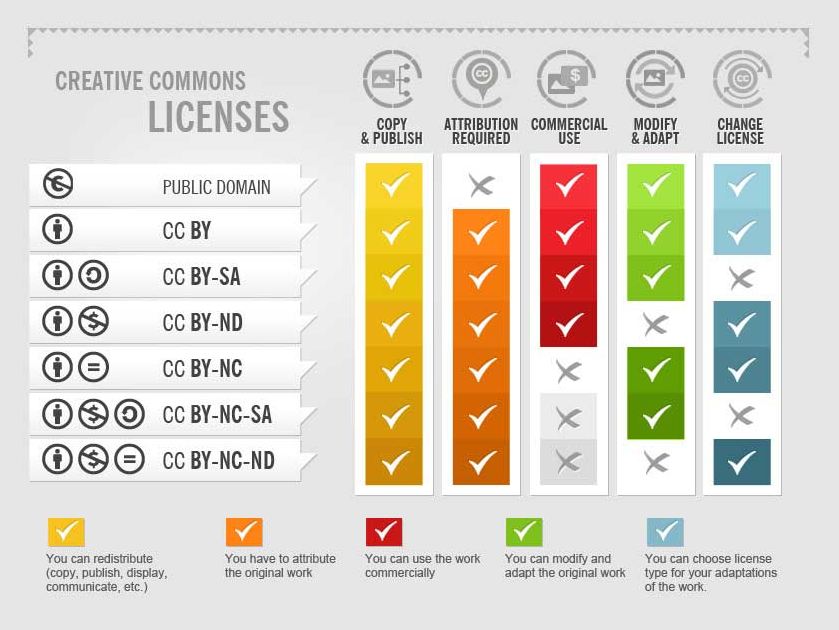
(Creative Commons Licenses image is available on the OER Essentials section of the ULS website and published freely under a Creative Commons Attribution 4.0.)
Recently, AI crawlers have added concern about CC infringements. AI technology does not recognize or abide by the CC license indicators. However, CC is proposing a solution called “CC Signals” (Hardinges et al., 2025). These will be visual and programmatic indications to AI robot crawlers that attribution is needed when information is gathered from OER sources. It is a work in progress, and CC has a website available for more information and support.
OER at Pitt
Are you curious about OER and where they are being used at Pitt? OER are being used across all Pitt campuses. The OER Commons website has a repository of OER designed by Pitt instructors and staff that range from subjects such as chemistry, Italian language, and physics among other topics. Erika Fanselow created and uses OER in her neuroanatomy courses so that students can create 3D models of the human brain. Khirsten Scott, a 2025 recipient of the Nancy Tannery Grant for OER, is working on creating a resource based on decades of teaching strategies for writing teachers. Other Pitt projects are listed on Pitt’s Open Educational Resources website.
Students can find out if a course uses OER via the course search function in PeopleSoft. Instructors can note in PeopleSoft that their course uses OER or no textbook by letting the University Store know via the regularly sent course materials adoption emails. If you are thinking about textbook affordability and finding OER to adapt, please see Pitt’s OER website for information.
Open pedagogy
OER are a starting point for instructors to turn resources into a teaching practice. Open pedagogy offers a shift in how we teach. Open pedagogy is a teaching practice that emphasizes experiential learning, in which students learn by doing. We examine open pedagogy through the framework of OER-enabled pedagogy proposed by Wiley and Hilton (2018). They describe it as “the set of teaching and learning practices that are only possible or practical in the context of the 5R permissions which are characteristic of OER” (p. 135).
Open pedagogy requires attention to two areas:
Focus on students: Open pedagogy encourages students to be active co-creators of knowledge. They should have control over their participation and work, and they need to give consent before their work is shared publicly. Consent is not assumed; it is requested.
Go beyond traditional assignments: Open pedagogy uses renewable assignments, unlike one-time-use assignments. According to Wiley and Hilton (2018), a renewable assignment should meet the following criteria:
-
involve students in creating an artifact
-
ensure the artifact has value beyond supporting the creator’s learning
-
make the artifact public
-
require the artifact to be openly licensed
If you want to try a renewable assignment, consider having students write open textbook chapters, edit Wikipedia, or create educational websites that extend beyond the semester. Essays could become Wikipedia entries, and annotated bibliographies could contribute to an open textbook’s references, adding to public knowledge. While there are many possibilities, it can feel challenging to get started:
-
Begin with a small step. You do not need to change your whole syllabus. Pick an assignment you already use in your class.
-
If you are starting with an essay or annotated bibliography, consider how much students would write. Try making it shorter, like a few paragraphs or entries. Shorter assignments let instructors give better feedback and make the task less overwhelming for students who are new to this. After that, use the renewable assignment criteria.
-
Give yourself time to test what works best for you and your students as you shift a traditional assignment into a renewable one.
For more examples of renewable assignments, visit the Open Pedagogy Notebook and Open Pedagogy Portal.
As we venture into using open pedagogy and resources, it is important to remember that not all our students come to our classrooms with the same technological starting point. Instructors should consider access issues, specifically technological policies and practices that reproduce digital inequality. The questions below can help instructors address these concerns (Jhangiani & DeRosa, 2017).
-
Do students have steady and reliable access to broadband internet?
-
Do students have access to laptops or tablets needed to engage with open educational resources (OER)?
-
Do students receive adequate support to creatively engage with unfamiliar technology tools?
-
Do students have the digital literacy skills needed to protect their safety and privacy online?
-
Do you understand the terms of service and data practices associated with the educational technology tools used in your courses?
Openness alone does not ensure equitable access and knowledge creation. It is important to ask: who gets access, who is represented, and whose ideas are included? Considering these questions among others can make open resources and teaching more accessible and inclusive. The open education movement is at a key stage and is gaining momentum. There is still much work to be done to improve adoption, sustainability, representation, and access. Join us to learn more and explore how you can get involved in using open educational resources and practices in your teaching at Pitt.
-
The Provost’s Standing Committee on Open Educational Resources (OER) is excited to announce that the Nancy Tannery Grant for OER is accepting proposals again this year. Pitt faculty and instructors, including graduate student instructors with a faculty co-applicant, are invited to apply for up to $5,000 to adapt, adopt or create OER for courses. Individual or team projects are welcome, and proposals are due March 18, 2026, with award notifications by the end of spring term.
-
Want to learn more about Open Pedagogy and OER? Join the upcoming UCTL workshop: Open Pedagogy: An Introduction.
-
OER Canvas Resource: Canvas OER Resources
-
University of Pittsburgh Library System OER Essentials
Maria Hahn is Senior Teaching Consultant at the University Center for Teaching and Learning and Sera Mathew is Director of Inclusive and Equitable Teaching at the University Center for Teaching and Learning. They both serve on the Provost’s Standing Committee on Open Educational Resources (OER) along with a group of amazing colleagues. Learn more about this committee’s work here.
REFERENCES
CC Signals: A New Social Contract for the Age of AI. (2026). Creative Commons. Retrieved February 9, 2026, from https://creativecommons.org/ai-and-the-commons/cc-signals/
Hardinges, J., Pearson, S. & Ross R. (2025). From Human Content to Machine Data: Introducing CC Signals. Retrieved February 9, 2026, from https://creativecommons.org/wp-content/uploads/2025/06/Human-Content-to-Machine-Data_Final.pdf
Jhangiani, R. S., & DeRosa, R. (2017). Open Pedagogy Notebook. Retrieved February 9, 2026, from https://openpedagogy.org/open-pedagogy/
Structured renewable assignments. (n.d.). University of Washington Pressbooks. https://uw.pressbooks.pub/structuredrenewableassignments/front-matter/introduction/
Wiley, D., & Hilton, J. L. (2018). Defining OER-enabled pedagogy. International Review of Research in Open and Distributed Learning, 19(4). https://doi.org/10.19173/irrodl.v19i4.3601
Wiley, D. (2026). Defining the “Open” in Open Content and Open Educational Resources – improving learning. Improving Learning. Retrieved February 9, 2026, from https://opencontent.org/definition