
By MARTY LEVINE
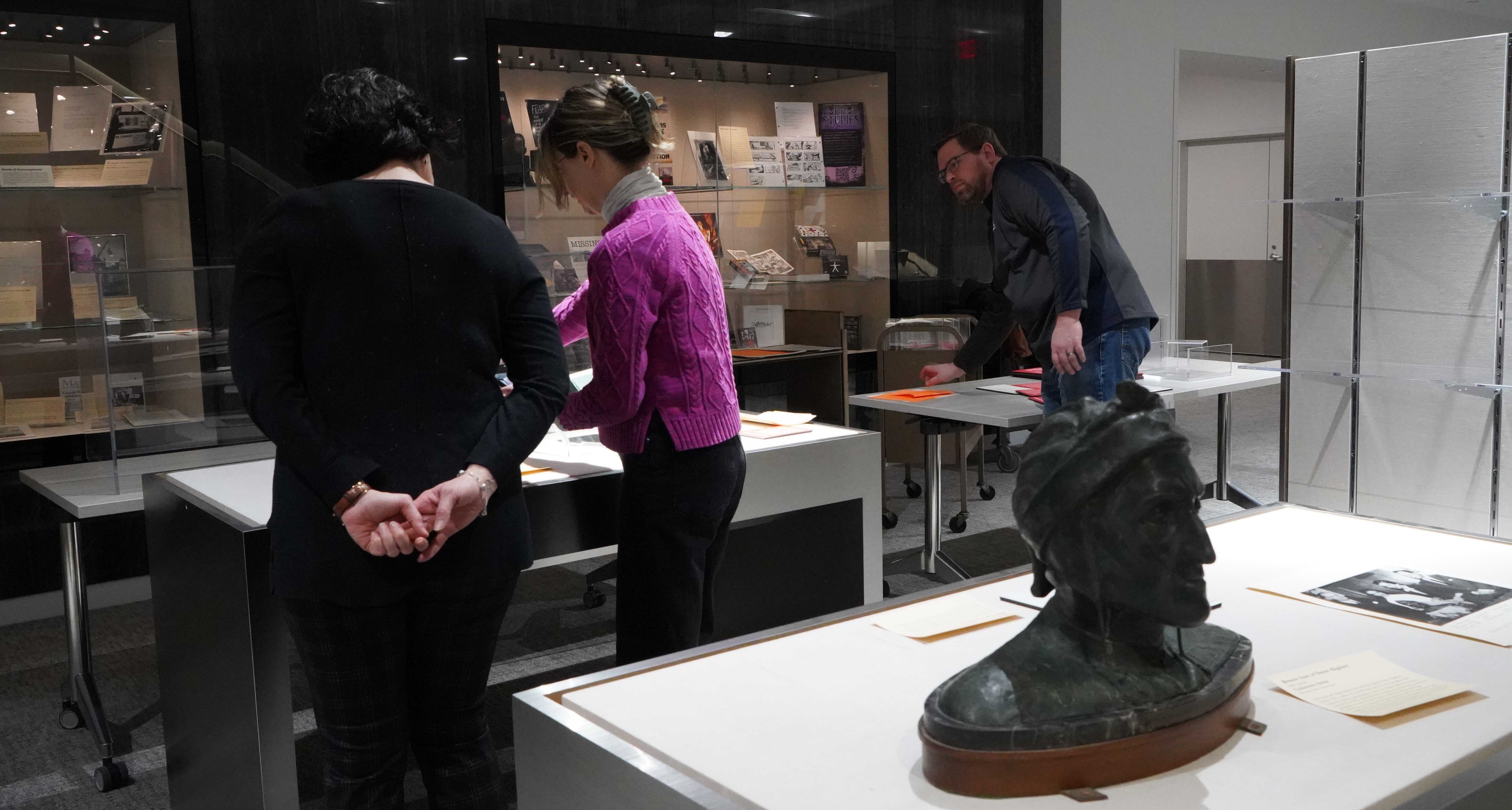
The 100th anniversary of the Nationality Rooms program, says director Kati Csoman, is “a perfect time” for exhibits on “the hidden history” of some of the rooms. Two new exhibits on the third floor Hyland Gallery of Hillman Library offer artifacts from the archives to show the surprising ways in which two of the rooms came to be designed and built.
EXHIBIT EVENTS
-
An opening reception will be held from 5 to 7 p.m. Feb. 26. Register here.
-
The Italian and French room exhibits will include gallery talks by each of the curators, at the exhibit spaces: from noon to 12:45 p.m. March 18 by Lina Insana, and from 11 to 11:45 a.m March 19 by Joanna Conings.
The French room was the product of a very personal relationship among the Nationality Rooms’ founding director and several women here and in France, before the official committee took over and got the credit.
The Italian room — like all the earliest rooms, carrying the image of local ethnic communities pitching in with their nickels, dimes and labor to get the room done — was actually the product of the Italian vice consul in Pittsburgh and a very wealthy woman from Florence who happened to be living here.
Alongside each exhibit’s curator, Csoman credits Zachary Brodt, University archivist and records manager, and Megan Massanelli, archives and special collections engagement and outreach librarian at Hillman, for their work in making the exhibits possible, as well as a pair of upcoming gallery talks about them.
Each exhibit, Csoman says, “is a representation of the kind of discussion and discernment that goes into the rooms,” offering “a deeper understanding of the rooms, the people who were involved, the cultural representations that are complex. These were regional ethnic communities who came together” to design classroom spaces that were “representative of their culture. That kind of decision making is complicated.”
In the French Room exhibit, “The Women Behind the Walls,” curator Joanna Conings, a PhD candidate in the Department of French and Italian, shows how the work and imagination of women shaped the ideas that formed the room, “through transatlantic letters, fundraising efforts, quiet negotiations and enduring personal relationships … to envision a space that would honor French intellectual heritage … and a vision for a room that would inspire future students” — as Conings wrote about their work.
Beginning in 1929 (14 years before the room was finished), Nationality Rooms director Ruth Crawford Mitchell corresponded with — and attended garden parties in the Pittsburgh home of — Rachel Hunt, a socially prominent Pittsburgher with connections to people of importance in France, including Yvonne Liard, who herself was involved in her country’s government and embassy.
Hunt recruited an early architect, who was nonetheless not employed by the room committee in the end, and the women debated whether the room should show a traditional academic space or more of a salon. The latter was rejected by the male committee but also, Conings says, dismissed by the women as not serious enough — because it was a traditionally female place.
Ultimately, these women were instrumental in getting the committee members involved. “Their work in the end is not remembered, as opposed to the committee,” Conings notes. She calls their letters and plans a kind of “affective diplomacy,” since the men were all business, but the women developed personal relationships: “Women ask about each other’s families and their personal struggles at home, their lives. It is also based on emotions — it links them. It is based on friendship and care.
“My life mission is to study women and their work and their voices,” Conings says. While, in French, the very word for the country’s cultural heritage is “le patrimoine,” Conings focuses on its alternative “le matrimoine.” “Let’s unveil everything women did in history but has not been valued,” she says.
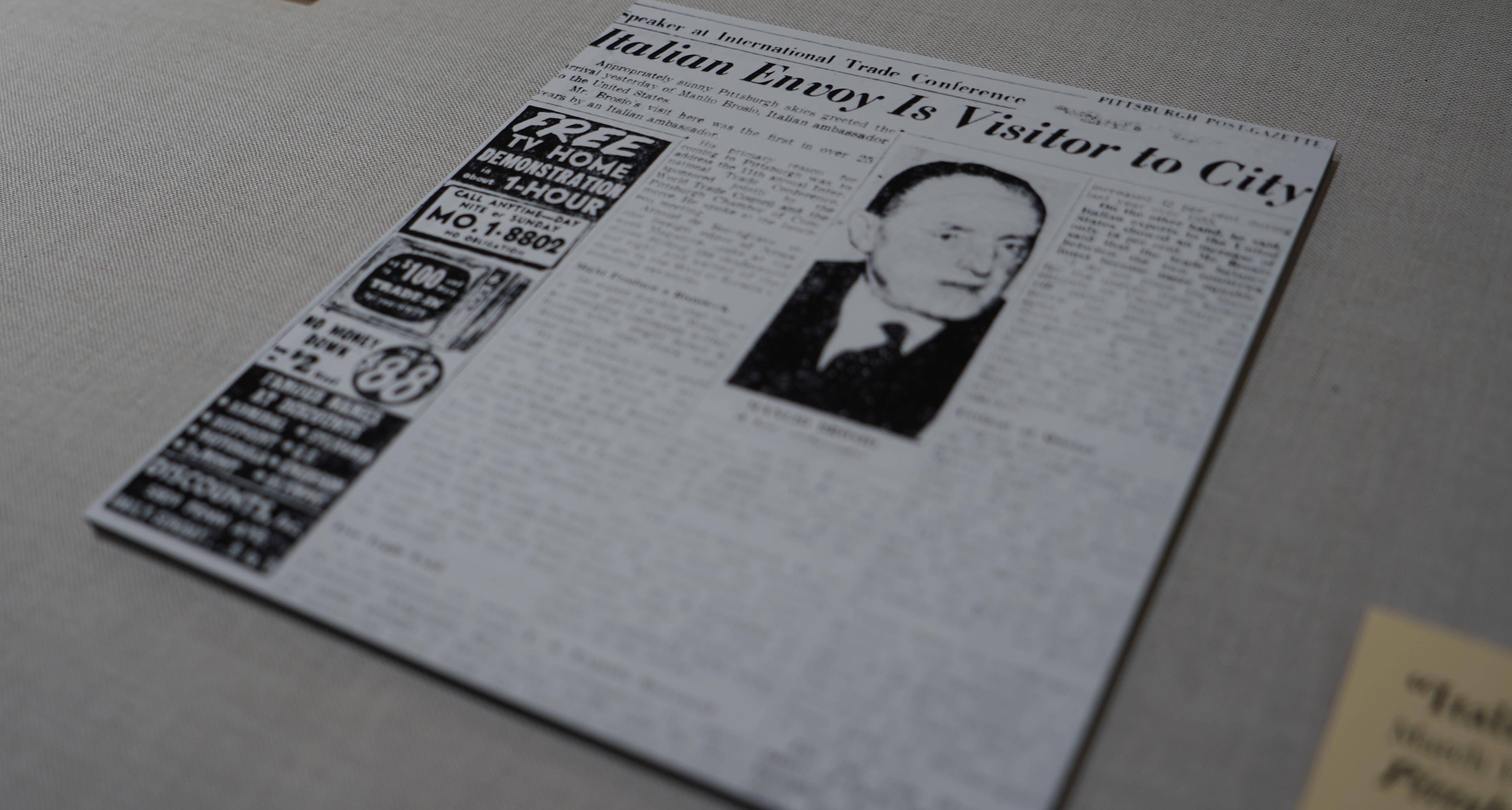
The Italian room exhibit, curated by Lina Insana, a French and Italian faculty member, is called “Read the Room! Uncovering the Italian Room’s Transnational Traces.”
Insana found in the 1934 and 1935 archives — a time when the Italian Room was first taking shape — that Don Leone Sircana, the honorary Italian vice consul in Pittsburgh, played a crucial role in fundraising for and creating awareness of the room. She also discovered that Margherita Chiari Langer, in Florence, also had an outsized influence on the shape of the space. Here in the ‘Burgh, “the immigrant community weren’t really in charge of a lot of decisions around the room,” Insana said.
The exhibit displays correspondence, photos, newspaper clippings and other archival artifacts, telling the story of this transnational effort. The exhibit also acknowledges the labor that created the room. Famously, Insana points out, a lot of the labor in the Cathedral of Learning was done by local Italian workers — its terrazzo flooring and the stone in the Common Room, for instance — but not within the Italian Nationality Room itself. Nor was all the material for the room sourced from Italy, as materials from the home country are often sought for Nationality Rooms.
She also discovered that one of the room’s features, a bust of “Inferno” author Dante Alighieri, is not original to the space, as was long thought, but rather arrived with the Italian ambassador in 1957. He was touring American cities to lobby for a lifting of America’s extreme immigration restrictions targeting southern Italians (and eastern European Jews) since 1924 — a product of the eugenics movement in the U.S. that was so strong it had once given encouragement to Hitler. That law would not be nixed until 1964, alongside the more famous civil rights legislation passed in that year.
“I hope the people will learn that ethnic spaces have really deep histories that we owe it to ourselves to learn about,” she says. That includes realizing that Ruth Crawford Mitchell was a pioneer in studying first-generation college students, as she researched learning outcomes and graduation rates of the Pittsburgh immigrants and their children at Pitt.
In March, Csoman says, the campus can also look forward to a trio of student presentations on the history of three other rooms, including the Irish and Czechoslovak rooms.
Marty Levine is a staff writer for the University Times. Reach him at martyl@pitt.edu or 412-758-4859.
Have a story idea or news to share? Share it with the University Times.
Follow the University Times on Facebook.