
By SHANNON O. WELLS
When Pitt’s Allison Borrasso first got involved with the nonprofit Leukemia and Lymphoma Society (LLS), now known as Blood Cancer United (BCU) in 2008, she was a fundraising participant in the organization’s Team in Training program, preparing to run her first marathon.
DONATE HERE
Click here to contribute to Allison Borrasso’s Visionaries of the Year Fundraiser for Blood Cancer United.
By 2020, Borrasso’s connection to the organization had become much more personal. After experiencing what initially seemed to inexplicable facial swelling, her 22-month-old daughter Sandy was diagnosed with B cell acute lymphoblastic leukemia.
Following extensive treatment, Sandy is now a happy and healthy 7-and-a-half-year-old girl who joined her mom to help with Blood Cancer United’s fundraising and research-driven mission.
“Sandy was chosen to be one of BCU’s Honored Heroes for (the 2025) Visionaries of the Year campaign,” said Borrasso, a research outcomes coordinator in Pitt’s Department of Neurosurgery. “She and I submitted various messages to the candidates last year, sharing Sandy’s story and sending videos of Sandy cheering them on.”
After getting to know Borrasso, who started her research career at Pitt’s School of Nursing in 2004, the staff at Blood Cancer United asked her to be a 2026 Visionary candidate.
“Although this type of fundraising felt out of my league at the time, and very intimidating, I knew I couldn’t say no. I saw it as an opportunity to put meaning to Sandy’s journey and show my gratitude to God for still having her with us today (and) advocate for others and for the continued need for research in this area,” she said.
“Little did I know it would become an opportunity for me to further heal from the trauma I experienced as a mother watching her child fight for her life.”
With the 10-week fundraising campaign concluding May 8, Borrasso is working with a team of 14 individuals helping her raise funds in a 13-team competition.
“I would love to raise enough money to win the medal to give to Sandy, but at the end of the day, I have already won because I still have her here with me today,” she said. “It is very moving to know that all of us candidates and our team members are working towards the same goal — a word without blood cancer.”
Borrasso took time to address some questions from the University Times regarding Sandy’s story and what led the family to commit to giving something back to potentially help others in similar situations.
University Times: Please tell us about your daughter and how her leukemia diagnosis came about?
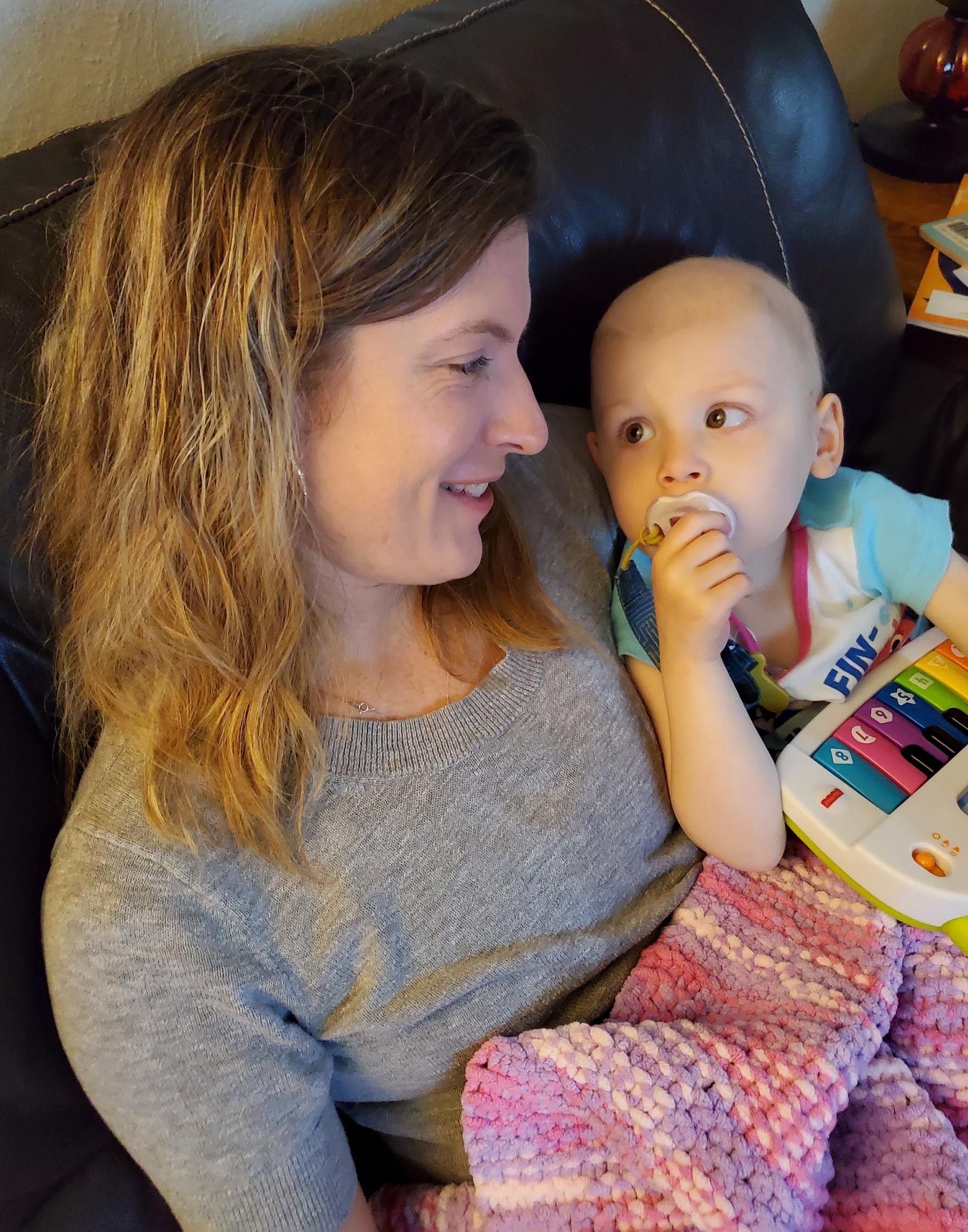 Allison Borrasso: My daughter Sandy was 22 months old when she was diagnosed with B cell acute lymphoblastic leukemia on July 23, 2020. Prior to this, Sandy had been experiencing facial swelling that we couldn’t get clear answers to as to why it was occurring. Sandy fell at preschool and split her lip open. Due to severe bleeding, we were encouraged to go straight to Children’s ER, thinking stitches were needed.
During the registration process, my husband pointed out a rash on her leg that recently popped up. … Sandy’s lip stopped bleeding, but we were still escorted back to an ER bed immediately. After further describing Sandy’s unusual facial swelling symptoms, coupled with the pinprick rash on her legs, bloodwork was ordered. The doctor informed us they would be looking for a variety of things, one being leukemia.
When the doctor returned with the blood results, she sat on the lid of the biohazard garbage can, and it was at that moment we knew it was bad. In that very next moment, our lives changed. Still to this day … my stomach turns remembering being told our baby girl had leukemia.
Within moments, we were taken up to the oncology unit of Children’s Hospital. Seeing the crib that Sandy would be placed in and remain in for many days was so frightening. This was the start of Sandy’s 2.5-year journey of intense cancer treatments, including a clinical trial.
This was in the midst of COVID, making the journey even more isolating for us as a family. But through it all, Sandy persevered with a smile on her face. It was not easy for her.
UTimes: What did Sandy’s treatments entail?
Borrasso: She had over 20 spinal taps to receive chemo into her spinal fluid due to leukemia cells being both in her blood and spinal fluid. She had multiple inpatient stays for multiple days at a time, ER visits anytime she spiked a fever, in-home nursing for treatment infusions, and weekly (and sometimes daily) clinic visits. Many types of medications were a part of her chemotherapy, some with possible severe allergic reactions and/or high levels of toxicity.
Steroids were a large part of her treatment, causing her periods of ravenous appetite. She had severe mouth sores and was nauseated quite often, making it hard for her to eat and keep down her life-saving medication.
But after 2.5 years of this … Sandy is presently a happy and healthy 7.5-year-old kid enjoying all of what a kid should be enjoying. I recognize not all kids and adults with blood cancer have this positive outcome, so this campaign is an opportunity for me to not only honor Sandy’s battle, but to also fight for countless others still fighting this terrible disease and provide hope for a better future.
UTimes: What do many people tend to not know or understand about blood-related cancers?
Borrasso: I lost my mom to breast cancer when I was 14 years old. That is actually what motivated me to sign on as a Team in Training participant for LLS. I was already supporting breast cancer-related organizations, but I felt moved to go beyond breast cancer. There is no “good” type of cancer to have. But that is what some people said to us shortly after Sandy’s diagnosis,
"Well, at least it is the good kind of cancer.” Now I understand that was their way of trying to be positive. Yes, Sandy’s particular cancer has higher long-term survival rates than a lot of other types of cancer, but there are so many factors that play into someone having a positive outcome versus dying from the disease: age at diagnosis, gender, genetic profile, etc.
At the end of the day, people are relapsing and people are still dying. Additionally, survivors can experience long-term consequences to chemotherapy. Sandy’s medical team will be watching out for long-term impact on her cognition and learning, as well as other health-related side effects that can occur later in life due to cancer treatments. While the treatment part of Sandy’s journey is behind her, the effects of chemotherapy very well may not have ended.
UTimes: What have you enjoyed about taking on the fundraising campaign? What are the challenges?
Borrasso: As uncomfortable as it is, I have enjoyed pushing myself out of my comfort zone. Those who know me well know that I am a people pleaser, and the last thing I want to do is burden others. So, when I am expected to reach out and ask people for money, I immediately viewed it as a burden to others. But this campaign has shown me that it is OK to ask the question and allow the others to say yes or no.
I have had many people decline to support or not even respond to my inquiry, but by no means do I take it personally. Because I am so passionate about making a difference, the roadblocks can feel overwhelming at times. I give myself time to breathe, reset and get back to it. I always remind myself that, just like Sandy, people battle cancer for months and years. I can take on this 10-week campaign and push myself to do things I normally wouldn’t do.
It is OK to feel uncomfortable. Ultimately, that discomfort is helping me evolve into a more confident and daring person … to live my life in a way that influences positive change.
UTimes: Are you aware of developments in research/treatment advances related to blood cancers? I found my father’s treatment options got narrower the older — and more in need of regular blood infusions — he got.
Borrasso: Your dad is now one of my reasons why I will continue my mission, because that shouldn’t happen. We need better treatments for kids and adults alike. I am proud to say that Sandy was part of a clinical trial that ultimately resulted in the experimental drug being incorporated into standard protocol. Blinatumomab is a targeted immunotherapy used in relapse patients, but they wanted to study the drug in the first round of treatments after diagnosis.
It was a difficult decision to consent Sandy into the study, but I am so grateful that she (was) randomized to receive the study drug. Many advancements have been made in the field of blood cancer that have influenced advancements in other types of cancers, making my involvement with Blood Cancer United even more meaningful.
I am so grateful to the countless patients before Sandy who contributed to research, which ultimately contributed to Sandy’s success story.
Shannon O. Wells is a writer for the University Times. Reach him at shannonw@pitt.edu.
Have a story idea or news to share? Share it with the University Times.
Follow the University Times on Facebook.