
By SUSAN JONES
The theme for the Pittsburgh National Day of Action for higher education event on April 17 was clear: “We are stronger together and we are what makes higher ed strong,” as the opening speaker said.
More than 200 people gathered at Schenley Plaza for the rally, many carrying signs like: “Resist”; “Don’t Comply in Advance”; “Pittsburgh Against Polio”; “Democracy Dies with Complacency”; “Hands Off Universities” and many more. One noted the recent stand by Harvard University against the Trump administration: “We Don’t Always Stand With Harvard, But When We Do We Crush Fascism.”
The Pittsburgh rally was one of many around the country organized by the Coalition for Action in Higher Education in collaboration with the American Association of University Professors. Locally, organizers included USW Local 1088, including faculty from Pitt, Point Park and Robert Morris, and Pitt’s chapter of AAUP, with support from the Pitt grad and staff unions.
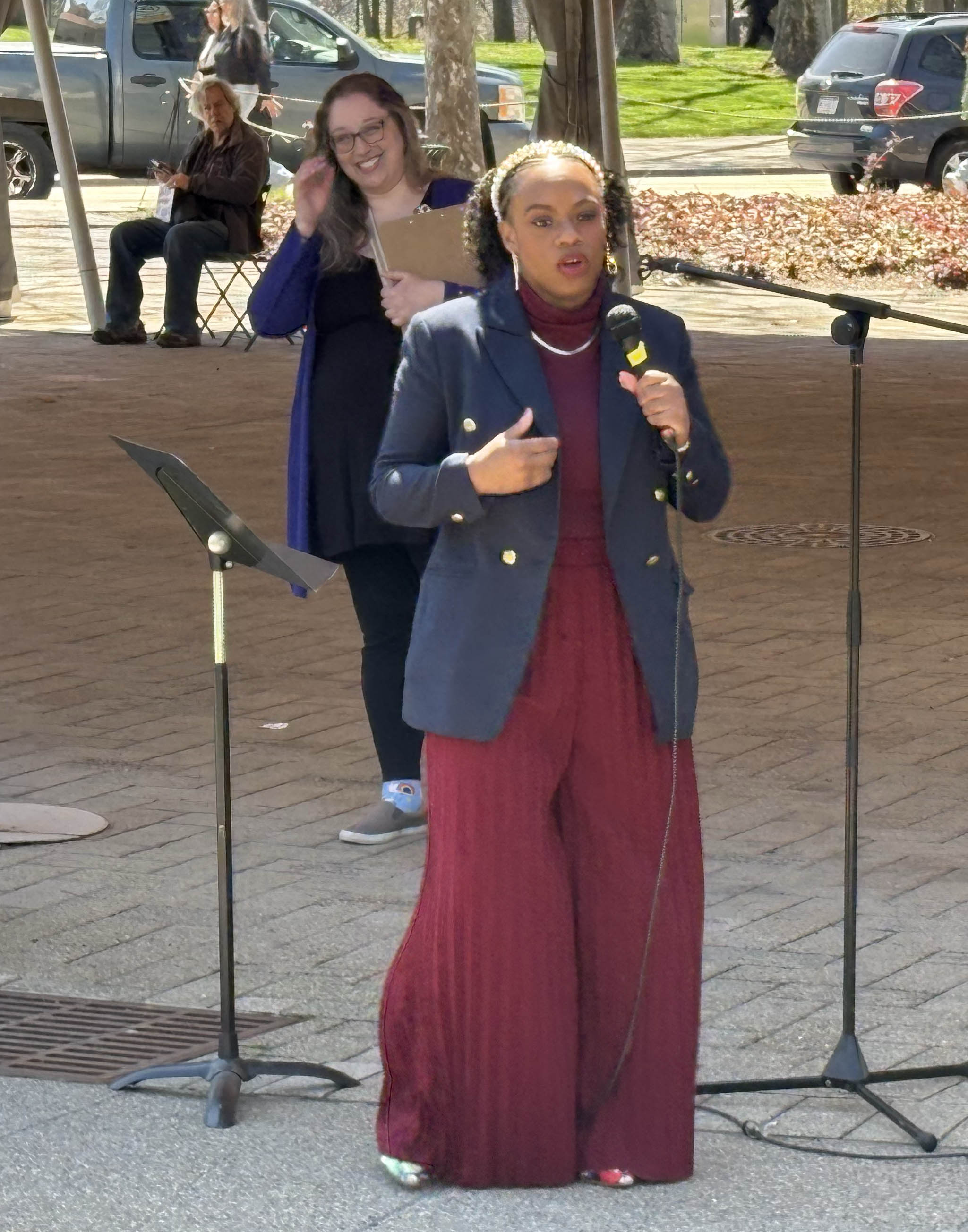
Speakers included U.S. Rep. Summer Lee of Pittsburgh; faculty, staff and a grad student from Pitt; and a history professor from Carnegie Mellon University. Each of them encouraged those at the rally and beyond to sign a letter to Pitt’s administration, which has several requests:
-
Issue clear, centralized guidelines to safeguard university spaces from improper immigration-related raids.
-
Clearly communicate a campus-wide process for appealing unjust federal grant terminations.
-
Commit to the University’s mission by avoiding layoffs and financial exigency in 2025–26 through bridge funding, fundraising and strategic use of endowment resources.
-
Form a University Crisis Task Force — that includes students, faculty, alumni and others — to implement these efforts and respond to evolving challenges, as Pitt did through the COVID-19 Task Force
“I’m here today because I don’t want my generation to be the last generation of professors, scholars and researchers to include first-gen college students,” said Ellen Lee, teaching assistant professor in the Classics Department and chair of the Civil and Human Rights Committee of the USW Local 1088. “I don’t want my generation to be the last to include black scholars, indigenous scholars and scholars of color. I don’t want us to be the last generation to include queer scholars, trans scholars, disabled scholars, working class scholars and scholars from other marginalized groups. …
“We are stronger together and we are what makes higher ed strong. Will we let them dismantle what makes us strong? Will we let them take away our academic freedom to research and teach our areas of expertise? Will we let them divide us up, drive a wedge between us, our colleagues and our students? No, because when higher ed is under attack, we stand up and we fight back.”
Megan Atherton, a member of the Pitt staff union and a researcher in the School of Medicine, related her experience of having a sick infant son who was cured by skilled doctors and nurses.
 “I can’t tell you the names of all of the doctors and the nurses and the staff who helped us throughout that time,” Atherton said. “And I cannot tell you the names of all of the researchers and the students and the professors and the technicians whose work over the past 10, 20, 30 years all informed his care. But I think about that. I think about that in my own work, in our cancer research lab, and how what we do today might inform someone else’s treatment and give them an answer to that question of, ‘What can we do in the face of this terrible diagnosis?’ Because that is how research works, and that is who it is for. …”
“When this administration guts research funding, when they use NIH grants as blackmail to demand obedience from our universities, they’re not just ripping our scientists away from our hard fought careers. They are robbing each and every one of us of the cures and the treatments that we deserve.”
Summer Lee said the Trump administration needs “to understand what America’s real power comes from. Because why would anybody who believes in America being great say that we don’t believe in research? We don’t believe in America being at the forefront of curing cancer or Alzheimer’s or creating the next societies. Why would anybody who says that they believe in America, attack education?”
Kyaien Conner, director of Pitt’s Center on Race and Social Problems and associate dean for justice, equity, diversity and inclusion in the School of Social Work, said, “In today’s current environment, silence is complicity. … They are relying on universities to weigh the financial implications of speaking out and to prioritize federal funding over their commitment to academic freedom, to science to diversity, equity and inclusion.
She went on to say that, “Some claim that DEI initiatives lower standards. This is false. DEI programs are designed to ensure that all individuals have equal access to opportunities and resources, enabling them to reach their full potential. By dismantling systemic barriers and offering robust support, DEI initiatives cultivate environments where merit and talent can genuinely flourish. These efforts are not acts of discrimination; rather, they are strategic measures to counteract and mitigate existing discrimination.
Jay Aronson, founder and director of the Center for Human Rights Science at Carnegie Mellon, used his time to talk about the damage the Trump administration is doing “to libraries, museums and humanities through the near complete dismantlement of the National Endowment for the Humanities and the Institute for Museum and Library Services.” He noted that the newly installed director of the IMLS has vowed “to restore the agency’s focus on patriotism … and relentlessly promote American exceptionalism.”
Michaela Cushing-Daniels, a Ph.D. student in the School of Public and International Affairs and a member of the grad worker union bargaining committee, said that grad students are feeling very vulnerable. “They are feeling alone, and they are looking to us, our union, to help protect them in these dangerous times. …”
“It’s up to us to use this moment, to use our collective power to achieve systemic change, to ensure that no one needs to fear abduction when exercising their rights to free speech and assembly, to ensure that diversity is actively celebrated and protected through policies that provide concrete, equitable pathways for inclusion, to insist that our campuses are safe places to work and teach for everyone, regardless of visa status, and to facilitate the research that we are all producing that is changing this world for the better.”
The rally concluded with Michael Goodhart, a Pitt professor of political science and of gender, sexuality, and women’s studies, exhorting everyone to action. “They’re attacking us because they understand, perhaps better than we do, that we are strong together. We are strong and so we have to fight together. We have a responsibility to fight for each other and for our students and for our institutions and for our country.”
Susan Jones is editor of the University Times. Reach her at suejones@pitt.edu or 724-244-4042.
Have a story idea or news to share? Share it with the University Times.