
The University Times reached out recently to some of the Pitt faculty who have had their federal research grants terminated during the past six months, to show the impact that these changes have had.
If you’re interested in telling your story, please contact us at utimes@pitt.edu.
Cassie Quigley, professor and chair, Department of Teaching, Learning and Leading, School of Education,
National Science Foudation grant
By SHANNON WELLS
In February, Cassie Quigley expressed concern that her National Science Foundation-backed project — based on integrating computational thinking and computer science into middle school English language arts classrooms — might be vulnerable to White House executive orders targeting federal grants for higher education research.
 Quigley consulted her project manager about what might happen to the remainder of the grant she applied for in 2021.
“Knowing that my grant is focused on increasing diversity in STEM fields, which is the purpose of the entire program, I had asked him, ‘Is my funding at risk?’” she said. “And he responded, ‘No. It’s (already) been awarded.’”
By that time — 20 months into a three-year timeline — Quigley had spent more than half of the $999,801 funding. She and her colleagues were reaching established goals including:
-
Expanding teacher participation from seven to 21 teachers across diverse school districts.
-
Developing and implementing prototype computational thinking and computer science curriculum in the classrooms of 15 active teachers, reaching 1,546 students.
-
Creating a flexible, online professional development course and providing in-class supports like instructional coaching.
-
Establishing a partnership with transformEd to enhance recruitment and access to educational resources.
Two months after conferring with her project manager, the grant was canceled.
“So things changed very quickly,” she said. “Even from (the project manager’s) perspective.”
The termination letter explained that the award was “ ‘not in alignment with current NSF priorities’ and ‘no longer effectuate(d) the program goals or agency priorities,’” Quigley noted. “The letter also advised that ‘there was no basis’ for appeal.”
Nonetheless, she and the project’s other principal investigators are appealing the decision, arguing that the termination was improper, she said. The appeal contends that:
-
The project remains aligned with NSF priorities: “We argue that the project aligns with both the original ‘Computer Science for All’ program goals and the updated NSF priorities emphasizing ‘Broadening Participation in STEM’ and creating opportunities for all Americans,” it said. “We also believe the project’s work does not violate the April 22, 2025, policy update against preferencing certain groups.”
-
The project aligns with federal AI education goals: The appeal highlights the project’s alignment with the “Artificial Intelligence Education for American Youth Executive Order” by promoting AI literacy and skills.
-
Proper termination procedures were not followed: The appeal asserts that the NSF failed to follow its own policies as outlined in the Proposal & Award Policies & Procedures Guide (PAPPG) and federal regulations. These require that the recipient be notified of any deficiency and given an opportunity to correct it before termination, which did not happen, the PIs said in their appeal.
“It’s a little tricky, because the letters that you receive from NSF say (grant terminations) can’t be appealed,” she said. “But written within the PAPPG — essentially the policy document — is required appeals, so we ignored the line in the letter … and appealed. It felt like our only avenue to try there.”
Quigley wrote the appeal in consultation with Jennifer Woodward, vice chancellor for sponsored programs and research operations, and the chancellor’s office.
“I wrote the appeal, they gave me sort of advice and structure, and then they reviewed it and gave suggestions, and they are the ones that signed off and submitted it,” Quigley explained. “So it felt like a team. It felt like I wasn’t doing that alone.
“I feel fortunate. … I know many at other institutions were not allowed to appeal. I was glad that Pitt was supportive and left it up to us to choose whether to appeal.”
There also are pending lawsuits that Quigley said could be an avenue for getting the funds reactivated. “So there’s some options, I think. I don’t think anybody’s holding their breath. I think we’re sort of doing in the spirit of, ‘This is absolutely what’s right.’”
Quigley said one of the more confusing aspects is that she thought many of the project’s goals were aligned with those of the current administration.
“I mean, the stated reason for the appeal cancellation is that it ‘does not effectuate the priorities of the administration,’ ” she said. “The purpose of the entire program, not just my grant, but all (Computer Science for All) in general, is to increase the diversity.
“That was your requirement, that you were sort of entering with this stance of, ‘We want to diversify the STEM education pipeline.’ Our student participants are from all over, and you work with teachers, and they teach all of their students, right? Sixty percent of our students are white.
“The other thing that made it a little difficult to understand about why it was canceled is that two days prior, (President Donald Trump) issued an executive order around computer science and AI education in K-12 classrooms, which was what we were doing,” she said. “That was part of the appeal. It’s hard to say that doesn’t align with his policies when he had put out an executive order saying this.”
Designed to reach students across 21 school districts in Western Pennsylvania, Quigley noted, the project was intended to achieve a significant impact through goals including: Broadening participation in STEM through designing and implementing a computational thinking/computer science curriculum for all English language arts middle school students; developing student skills and confidence; and building teacher capacity.
“Early results indicated that students were making connections between ELA and CS, leading to increased confidence and interest in the field,” Quigley said. “This was seen as a crucial step in forming a strong STEM occupational identity, which is linked to persistence in STEM careers.”
Termination of the grant 20 months into its three-year duration, Quigley explained, has had a “significant negative impact” on both the research and individuals involved.
The project coordinator will be terminated one year earlier, with the graduate student losing access to data and funding through the grant.
Quigley said she met with the graduate student, who “lost her funding around this and as a result, loses her dissertation work. It’s literally ‘poof.’” They discussed “how we can reframe and rethink this work together and (determine) what is salvageable. Then, sort of thinking forward, next steps, like ‘What funding streams do we want to go after? Can we do any of this work without funding?’ So we’re trying to problem solve that.”
The project was terminated just before planned collection of post-implementation data in May and June 2025, which prevented a rigorous evaluation of the curriculum’s impact on students’ CT/CS knowledge and identities, especially for underrepresented students.
Termination halts the systematic study of how specific instructional supports, such as modeling and co-teaching, help teachers integrate CS and ELA.
The 1,546 students involved will no longer benefit from the integrated curriculum. The 15 active teachers will lose the ongoing support structures facilitating to teach CT/CS concepts. In addition, three professional development sessions planned for the summer were cancelled, which could have reach 75 more participants.
Despite having the financial rug pulled out from under her and the project, Quigley has plenty to keep her busy this summer.
“I feel like the last couple months have been really intense in terms of figuring out how to close the grant and terminate it and get the proper paperwork and the appeals and the budgets,” she said. “As it turns out, it’s actually a lot of work to terminate a grant immediately.”
Shannon O. Wells is a writer for the University Times. Reach him at shannonw@pitt.edu.
Ruth Mostern, professor and World History Center director, Department of History, Dietrich School of Arts & Sciences,
National Endowment for the Humanities grant
By MARTY LEVINE
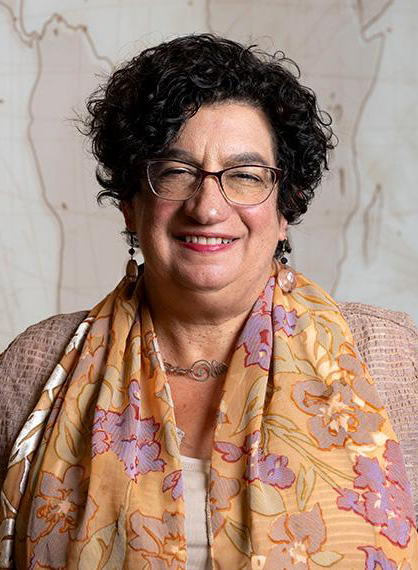 “This is a huge blow personally but, of course, to every field I am involved in and every field I know about,” said Ruth Mostern, Pitt history professor, about the termination of her current grant from the National Endowment for the Humanities.
It was the third grant over the past 10 years Mostern had received from the NEH to fund the World Historical Gazetteer from the ground up. The project helps both faculty and the public turn worldwide place-specific datasets into fresh visualizations — charting, across time, the changing peoples and histories of locations around the globe.
“This project that has been transformative to Pitt, has been transformative to historical information science and has been transformative to my career,” Mostern said, and represents 10 years of work. “This is very distressing on very many levels,” especially since she was already working on another NEH request, joined by another institution.
Still, she counts herself as somewhat fortunate among grantees, since she was two and a half years into a three-year grant and only about $30,000 remained unspent. Social media discussion of the situation more than a month before her grant’s official termination alerted her to the situation and allowed her to accelerate her work and spending schedule as much as possible.
And next month Pitt will open the new Institute of Spatial History Innovation under her direction, which will provide the basic funding for her staff and the Gazetteer website.
The Trump administration’s 2025-26 budget proposal would end both the NEH and the Institute of Museums and Library Services (another federal Gazetteer funder in the past), which would not only hinder Mostern’s future scholarship but also will prove permanently harmful to everyone from early-career faculty who need support for their work to those who might have been granted time off to write books, attend summer institutes to learn new scholarship approaches or work on curricular design.
Mostern has sat on many grant review panels for NEH applicants over the years and now mourns “the amount of extraordinary work that I was able to learn about in its early stage, that I had the honor to evaluate.”
She points also to a long history of local institutions being funded by the NEH, including WQED’s public television offerings, the Carnegie Museums and libraries, nearly all local institutions of higher education, Phipps Conservatory and on and on.
“The NEH was the major institution that has, maybe for the last 20 years, been fueling the fields of the digital humanities,” she said. The NEH has been “absolutely forward looking and visionary in recognizing the potential of the field and recognizing the kinds of grants that were needed. …
“There is simply no possible public or private funder that can fill that gap. There is nowhere else that is supporting this kind of work, and no corporation will ever fund this. This is not the kind of work that will ever make a profit. ... This is important to knowing who we are as people. If the government steps back from this in total, it is simply not going to happen.”
A student working under Mostern on another project also left the country in a hurry “out of a legitimate fear for their future liberty,” she said. “That project was never completed and probably will never be completed.”
Current federal moves will have “an impact on the whole field of cutting-edge humanities research,” she said. “Although the impact on my project is relatively limited, my project is part of a vibrant infrastructure in the digital humanities and that whole infrastructure will be irreparably damaged.”
Marty Levine is a staff writer for the University Times. Reach him at martyl@pitt.edu or 412-758-4859.
Have a story idea or news to share? Share it with the University Times.