
By MARTY LEVINE
There is nothing physics faculty member Wolfgang J. “Jim” Choyke seems to like to talk about more than the work he has done here since 1974 — the work he has done beginning in 1955 at Westinghouse locally, and the work he continues to stay up to date on past his 100th birthday this summer.
In his small office in Allen Hall, the past looms overhead, in jammed bookshelves that also hold the records of his endeavors. But the future — and the current work in physics that creates it — is first on Choyke’s mind: “I love what I’m doing and I love talking to my colleagues. That’s one thing that keeps you going. I am very excited to hear them talk” about new things they are doing.
When people ask him why he never retired, he notes that some retire to pursue a hobby, but “I don’t have time for a hobby. Physics is very competitive, so you work seven days a week to do a good job. You shouldn’t go into physics if you’re not completely dedicated.
“I keep up with a lot of colleagues, on the e-mail and telephone,” he adds — including a group at Montana State University whose experiments on silicon carbide as a semi-conductor continue the focus of his own laboratory here, which ceased operation when he was 93 — too early, Choyke says.
Choyke was a pioneer in silicon carbide work. Today, out in Montana, his fellow researchers seem to have hit a snag in aiming to reduce the substance’s kinetic energy as near to zero as possible, he explains. using 1- to 10-micron-sized bits of silicon carbide with next to no kinetic energy would allow for “super-sensitive magnetic measurements,” he says, which would have lots of applications. Which applications? “It hasn’t come to that part yet,” he says.
“Have plenty of patience,” he advises anyone starting out in the study of physics today. He began studying silicon carbide 70 years ago at Westinghouse “and it’s only today that it’s a worldwide multi-billion-dollar industry,” allowing for high-power, high-voltage, high-temperature chips that run electric cars, for instance.
He joined Pitt from Westinghouse, he said, because “that was a time when the funding for silicon carbide went more or less to zero, so I got sucked into the fusion program” at the University. He first came here as an adjunct professor, working right away in Allen Hall as well as in the Van de Graaff Building behind it.
“The first days were very complicated,” he recalls. “They really didn’t have a place for me to have an office,” and he was shuffled around until they could find a permanent space. Eventually he and the fusion scientists already here found a new collaboration using their particle accelerators. That’s when he knew, “this is going to require a very ambitious program.”
“I knew exactly what we were trying to do, but I had to figure out the lay of the land … and we had to figure out how to build all this stuff in a nuclear physics lab.”
One of the greatest joys of the job, he said, was attending international conferences all over the world, “instead of taking vacations. I’ve been to almost every place in Europe and many times to Japan.”
He taught upper-class mechanics and electromagnetic theory to freshman physics students. “I liked teaching very much, but I hated making up exams and grading exams and all the paperwork.
“I had a very strong feeling that undergraduates should be able to join a research group,” he adds, “to get a feel of what graduate work is all about and to get a bit of a feel of what hands-on work is all about.” Beginning with two to three undergraduates joining the graduate students in faculty labs, since then he has counted 95 undergraduates participating in his department’s research programs.
“I still keep in contact with a lot of these kids,” he says, showing a 100th-birthday email that arrived from a 1970s student, crediting Choyke with teachings that guided the student’s entire career. He hears from former undergrads that lab work was their most meaningful experience at Pitt, he says.
“These kids need to be talked to,” he says, suggesting extra attention to undergraduates in the department. “You need to take time to give them personal attention.
“I personally do not believe that people learn anything from watching slides,” he offers.
“It’s a complete waste of time. The way you learn anything is through a pen” — through the act of absorbing and writing down what the instructor says and, in the process, making sense of it.
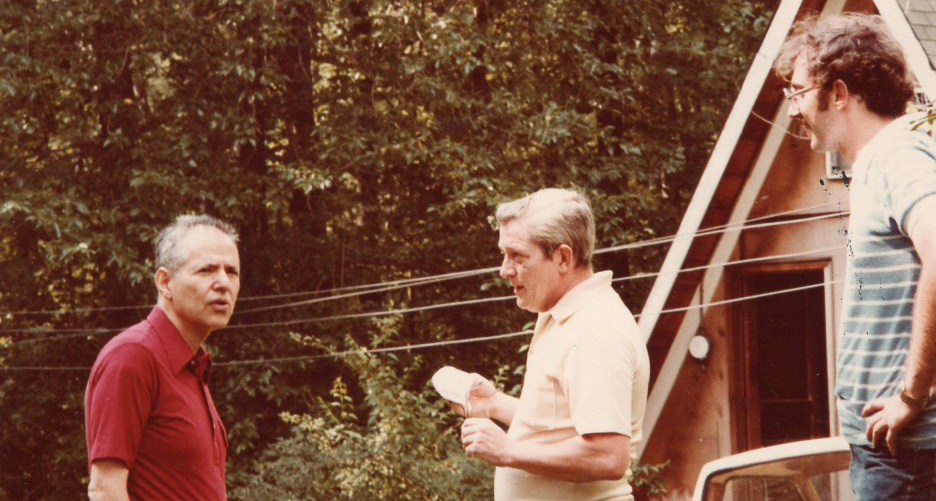
He remembers with great fondness the annual departmental picnics at the home of Professor Jim McGruer “somewhere beyond Murrysville. It was always a joyous event for professors, postdocs, graduate students, undergraduates and technicians.”
When he first arrived on campus, it was actually possible to park right next to the Van de Graaff Building. And Allen Hall still held a remnant of some sort of work — he isn’t certain what — on its fifth floor. That remnant was the smell: “It turned out that in the early years of Allen Hall, the Mellon Institute kept live research animals on the fifth floor. Their effluence seeped into the floor and whenever there was a flood of sorts on the fifth floor” — sometimes there were leaks during heavy rains or snow — “our labs on the fourth floor would get a whiff of the ancient past.” Happily, he says, cleaning and renovation eventually fixed all of that.
He remembers his seats in Oakland’s famed Syria Mosque, just behind Jonas Salk one season, and one particular concert of the Pittsburgh Symphony Orchestra featuring a Dvořák cello concerto by Zara Nelsova under conductor William Steinberg. He and his brother-in-law braved a winter storm to sit among just 250 people there. “Before the concert, Steinberg, who never talked to the audience, invited everyone to move to the front rows of every section. After the concert Steinberg remarked, “‘Now I know who the real music lovers are in Pittsburgh.’ We had to fight our way home in the snow.”
Nowadays, Choyke comes in to the office only once a week, working at home more often than not. But he still likes to shepherd people through the Cathedral of Learning and its Nationality Rooms: “I like taking people around and showing them the University.”
Marty Levine is a staff writer for the University Times. Reach him at martyl@pitt.edu or 412-758-4859.
Have a story idea or news to share? Share it with the University Times.
Follow the University Times on Facebook.