
By SHANNON O. WELLS
In the Oakland-based Pitt community, Posvar Hall serves numerous purposes for a multitude of people, offering a convenient, centrally located place to study and lounge; computer labs; a home to the School of Education and College of General Studies; and the large second-floor conference room is where Senate Council and Faculty Assembly meet each month to discuss news and policy.
What few realize is that, behind the scenes — both above and below Posvar’s cavernous public corridors, study nooks and labyrinthine office suites — the sprawling five-story building also houses Pitt’s Thermal Management System.
Somewhat reminiscent of the surreal contraptions illustrated in Dr. Suess children’s books, the elaborate network of curving, colored pipes, alongside pumps, valves, tanks and electronic controls, regulates and distributes steam and water to heat and cool buildings and equipment throughout the University’s lower and mid-campus.
An $18.8 million project begun in October 2022 to update the system’s chilled-water plant — including an innovative, new stormwater collection system to reduce use of municipal water — is well on its way to completion by the end of April, said Scott Bernotas, vice chancellor of facilities management.
The project replaces infrastructure and equipment, dating to Posvar Hall’s completion in 1978, that’s outlived its useful life while installing the stormwater-capturing element.
The project will include:
-
Renovation and upgrades to three of the existing cooling towers.
-
Purchase of two new 2,250-ton chillers;.
-
Installation of new underground chilled-water distribution and stormwater piping with connection to new piping installed as part of the Bigelow Boulevard renovation project.
-
Installation of a 250,000-gallon underground stormwater collection tank.
“We are replacing two of the five chillers,” Bernotas explained. “We’re replacing a lot, but not all of the piping. We replaced three of the six cooling towers (on the roof). So, it’s a huge overhaul of the plant.”
Using a system of refrigerant, pumps, electronic controls, evaporators and condensers, the chilled-water plant centrally cools water to around 42 degrees. The water is propelled through pipes to most buildings on the lower and mid-campus for air-conditioning — even in winter to cool heat-generating laboratory and information technology equipment — and supplying refrigerators and freezers in dining facilities and research labs.
Once it’s served its purposes, the water returns to the Posvar plant about 10 degrees warmer than when it left. Then the cycle continues.
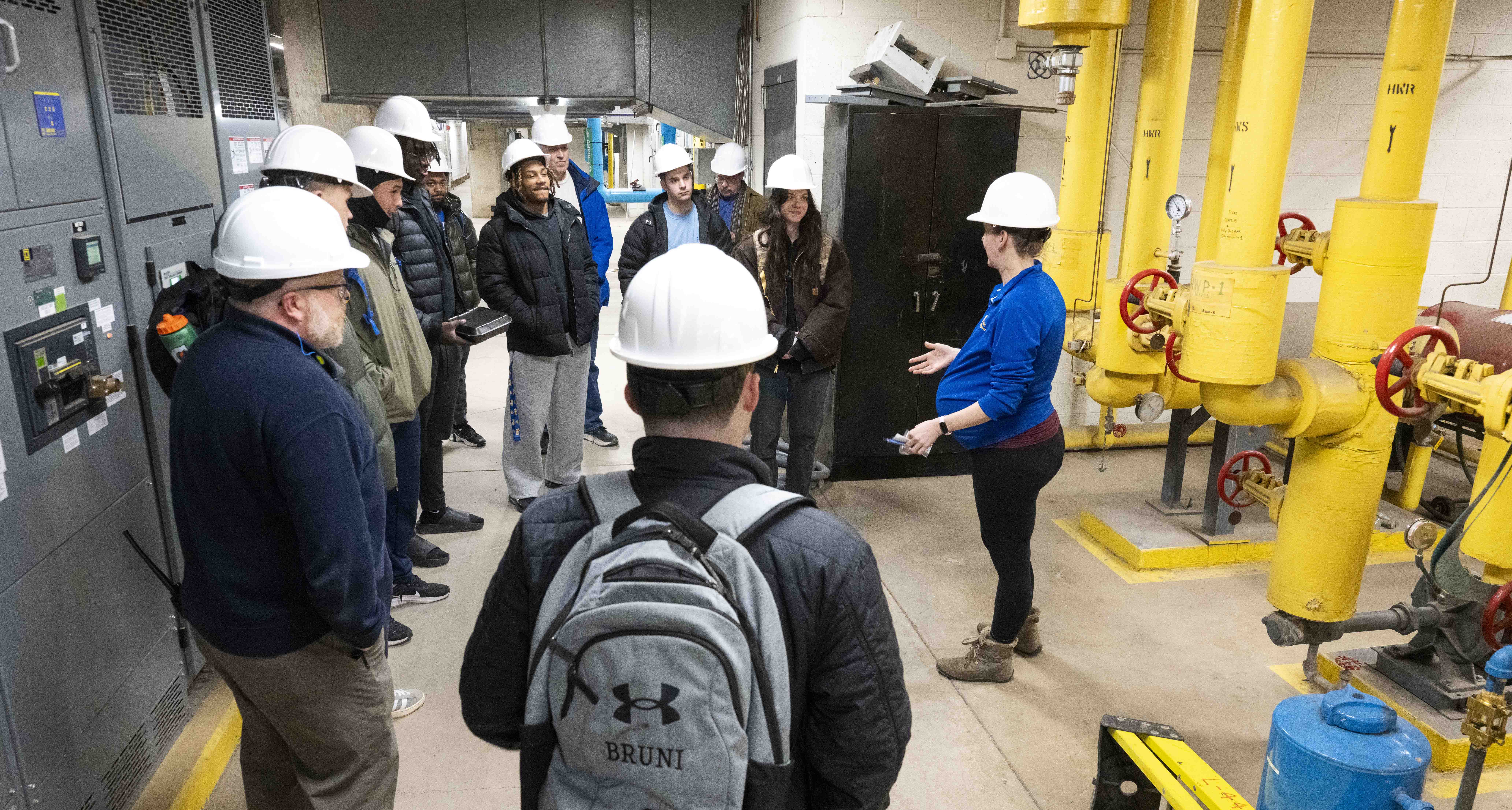
“It’s like a big home refrigerator, almost,” physics Professor Pat Gallagher explained during a recent tour for his Physics in Energy class, surveying the vastness of the underground plant. “It’s the infrastructure for a medium-sized city.”
Of course, even as renovations move forward, the plant must continue its role of supplying chilled water around campus.
“It is a pretty major project,” Bernotas said, noting the greater demand for chilled water during warm-weather months. “(The plant’s) got to maintain service, so we’re limited to what we can do through the latter part of spring and into fall. We could do more work than in the winter, but even then, we try and keep everything cool and continue to provide chilled water the campus needs, which is year-round for that plant. I think that’s the tricky part.”
“The new design is going to be able to allow us to isolate things,” he added. “And it’ll be easier in the future to do work on the plant.”
Renovations high and low
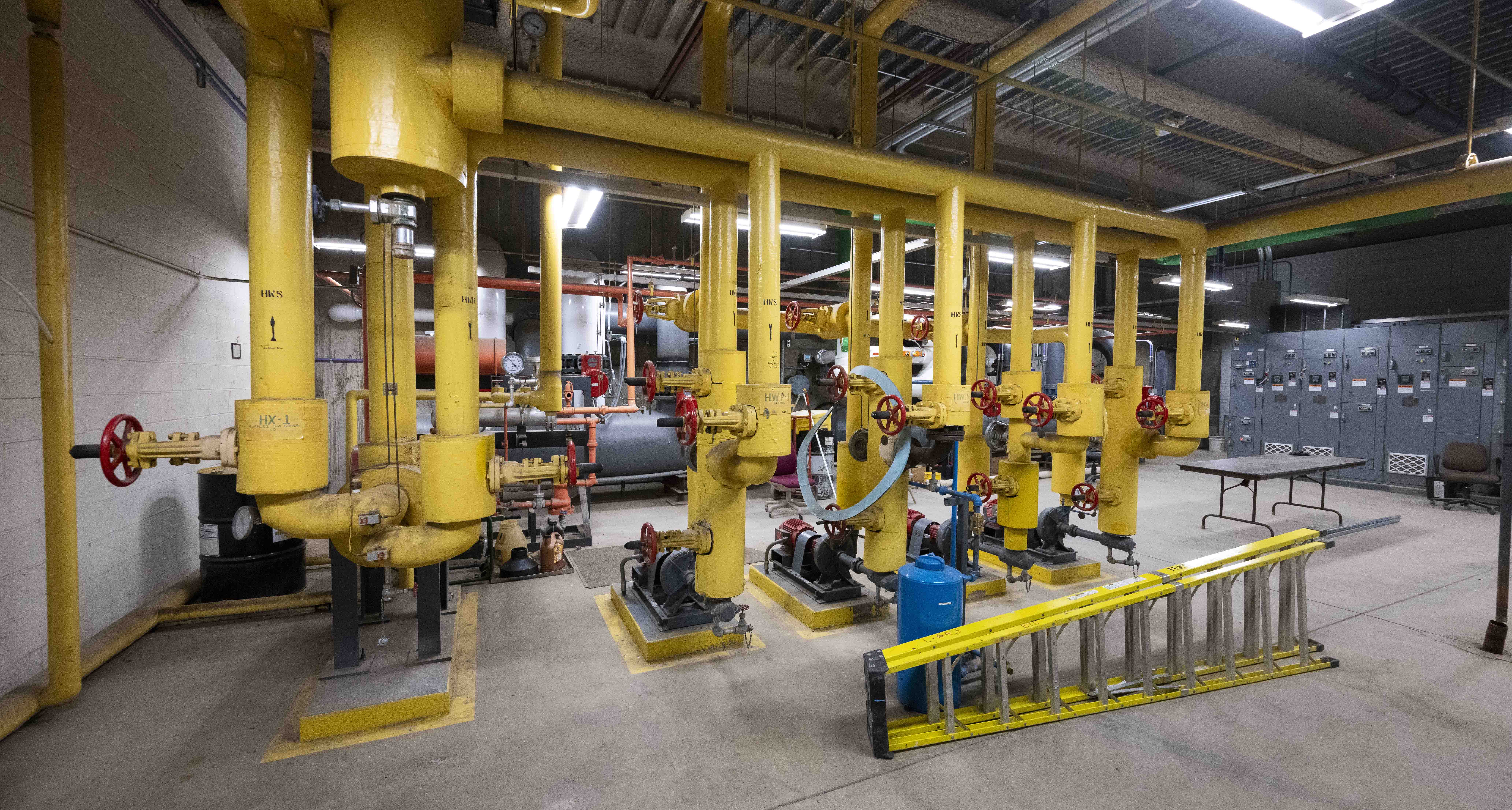
Incorporated into the basement and penthouse sections of Posvar Hall, the Thermal Management System was completed in 1978 and has undergone various upgrades and equipment replacements through the years. Improvements — including increased distribution capacity — supports current and future campus demand while addressing aging, less-efficient equipment.
“The water plant has had various renovations through time — a little bit here, little bit there — but this is the first major system rehabilitation,” Bernotas said. Three cooling towers and two of the five chillers were replaced three years ago.
“All of this is going to increase the plant capacity,” he added. “We’ve also replaced some of the main distribution lines from the plant, because they’ve gotten old.”
The Posvar Hall project follows the November 2023 dedication of a three story, 45,000-square-foot chilled-water plant on the upper campus near the Pitt Sports Dome.
Approved by the Board of Trustees Property & Facilities committee in summer 2021, the $117 million project — which included a new electrical substation — was needed to support upper campus construction projects and tie into parts of the existing chilled-water network.
That project provides existing and future campus buildings — like the Campus Recreation and Wellness Center and Arena and Sports Performance Center already under construction — with central cooling and electrical capacity.
The three industrial chillers housed in the building have a capacity of 7,500 tons of chilled water. The facility is designed to accommodate up to three additional chiller systems and ultimately carry up to 15,000 tons of water.
Effective yet invisible
Like the new plant high upon the hill, renovations at the lower-campus facility at Posvar Hall are designed to capture stormwater from rooftop drains and send it back to the chilled water plant tanks for reuse. Stormwater/gray water distribution piping was installed to direct water into a 250-gallon cistern underneath Mazeroski Field on Bigelow Boulevard.
 Capturing and reusing the stormwater will allow the University to consume less treated municipal water by relying more on rainfall.
“The intent there is just like we’re doing with the new plant on the upper campus, to capture stormwater off the campus and then be able to use it as part of the makeup water for the cooling towers,” Bernotas said. “This captures stormwater off the roof of buildings through — we call them drain leaders — takes it down and puts it in this tank.”
Historically, the chilled-water system has relied on “pulling in city water, which we have to pay for,” he explained. “This allows us the ability to recycle some of that water and use it in the cooling towers. … It also allows us to mitigate all the stormwater runoff from the campus into the watershed downstream and in Panther Junction and other places,” he added. “It has that benefit as well.”
Longer-term plans include connecting the Posvar and Petersen/upper-campus chilled-water plants. “The ultimate goal is to tie those two plants together … the lower campus and the upper campus,” Bernotas said. “Physically, there’s a big elevation change, which makes it a little difficult to connect the two. So that’s a future project.”
He called the Posvar Hall plant upgrade a “big step up in terms of overall plant efficiency and extending the life of the plant and the distribution lines,” as well as making the valves such that “we can do more work on the plant without interrupting the service of the plant. It’s more efficient.”
That said, when the project is completed this spring — just like the hidden nature of the plant infrastructure itself — none of the thousands who stream through Posvar Hall or around lower campus every day should notice anything different than before.
“If you use Mazeroski Field, it’s gonna look just like it did before, (even though) there’s a big tank underneath it,” he said. “If you walk in Posvar, it’ll look the same. If you look down on the chilled-water plant, you might, if you had seen it before, you would note that something’s different.
“But with the new and the old stuff there, to the untrained eye, it will look like it always does.”
Shannon O. Wells is a writer for the University Times. Reach him at shannonw@pitt.edu.
Have a story idea or news to share? Share it with the University Times.