
By SHANNON O. WELLS
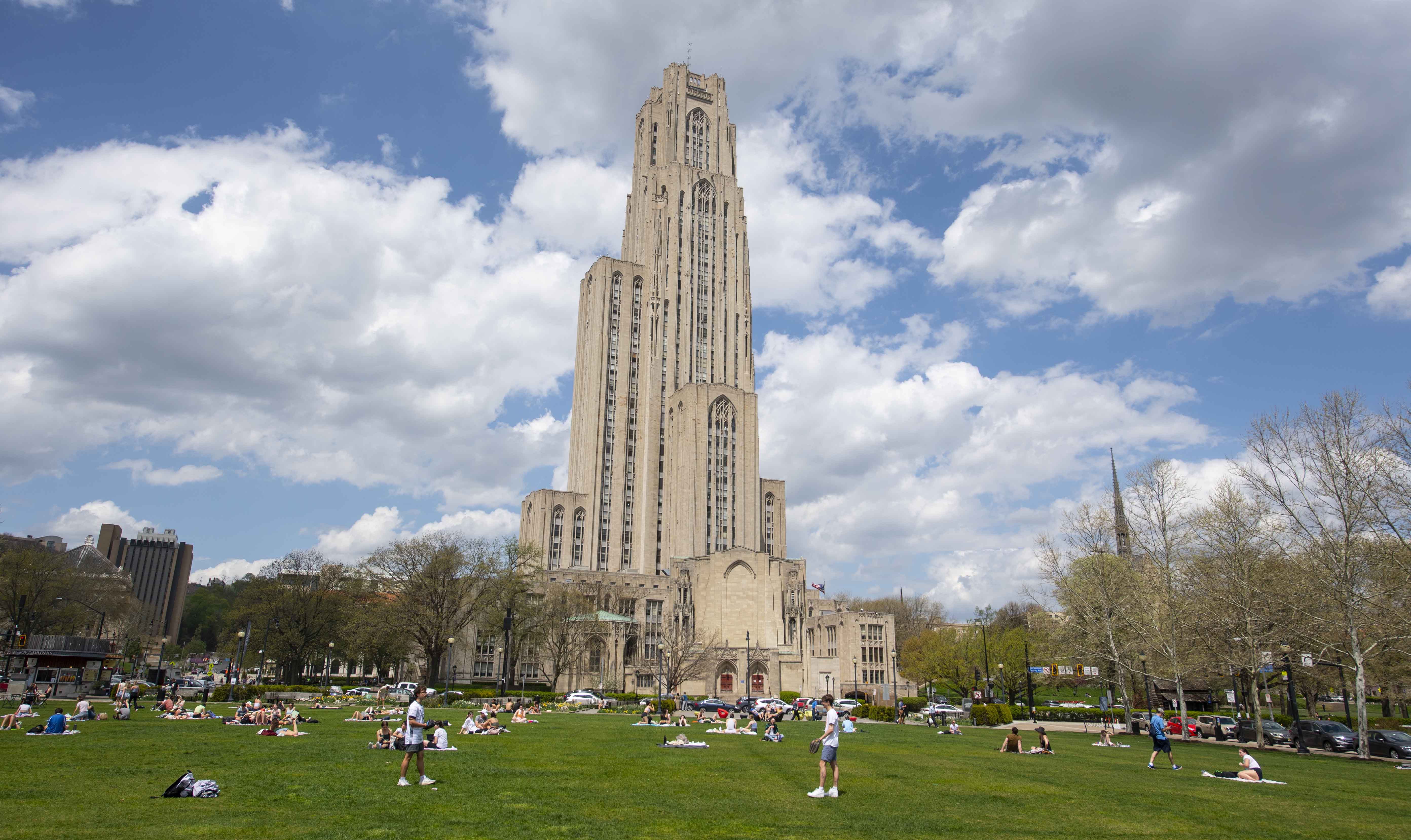
In the past century-plus, Schenley Plaza on Forbes Avenue has morphed from farmland gully to leveled-off asphalt parking lot to the beloved, multi-faceted greenspace in the Cathedral of Learning’s shadow it has been since 2006.
Along with considerable vision and force of will, the transformation required substantial investment of capital from governmental entities, institutional partners and individual contributors. Like with many community improvement projects, coming up with the $12 million required would be, hands-down, the hardest part.
CELEBRATE ON JULY 25
The Schenley Plaza 20th Anniversary Jubilee will take place from 11 a.m. to 6 p.m. July 25. The Pittsburgh Parks Conservancy describes the free, open-to-the-public Saturday event as a “joyful day of music, family fun, and community celebration in the heart of Oakland.”
The jubilee will feature free PNC Carousel rides, live entertainment including a 21-piece big band from Azure Family Concerts, fairytale character appearances, balloon artists, face painting, caricatures, local vendors and “more surprises.”
“It’s going to be a really festive celebration truly for people of all ages to come enjoy,” Wenk emphasized. “Obviously, there’s a lot of family-friendly attractions there, but it’s something that, even if you don’t have little ones, you’re able to come out and enjoy what we’re going to have at the celebration. And it’s free and open to everybody.”
However, this was Oakland in the early 21st century. A more powerful factor was at play.
“Probably the biggest obstacle was people’s reluctance to lose the parking,” noted Richard Reed, who serves on the Pittsburgh Parks Conservancy’s Board of Directors. “After that it was raising the money for the construction.”
Parking was, in fact, considered in the plaza’s original design, as a grand entrance to the sprawling Schenley Park in the early 20th century. Its immediate proximity to Forbes Field, then home of the Pittsburgh Pirates and Steelers, hastened its transformation to more utilitarian use.
“It ended up discouraging people from actually enjoying the space that was there. That’s why it became converted fully to parking years later,” said Alana Wenk, the Parks Conservancy’s director of marketing and communications. “Then Pittsburgh Parks Conservancy enters the conversation, and Pitt was a big supporter of this, obviously, the city, the state, many key players made this happen.
“Taking parking out of Oakland, of all places, and transforming into a green space back in the early 2000s — that was a big deal. And obviously met with supporters and opposers,” she added. “Ultimately, we rallied together, and the vision came to life.”
In June 2006, Schenley Plaza officially reopened as the central gathering place it is today. Operated and managed by the Parks Conservancy, the 4.5-acre space boasts gardens, a one-acre “Emerald Lawn” of grassy, wi-fi-accessible park space, a Victorian-style carousel, a big-top tent, food kiosks, benches, picnic facilities and a full-service restaurant.
Richard Reed served as the Pittsburgh Parks Conservancy’s chairman when it was relatively new organization with what he called a “successful track record of restoring parts of the city’s parks.”
“There was a discussion across the city and particularly in Oakland on the possibility of restoring the plaza,” he explained, noting that Conservancy founder and then-president Meg Cheever recognized it was “imperative for the long-term credibility of the organization that we, rather than any other group, take on Schenley Plaza, given it is part of Schenley Park.
“It was the most high-profile and expensive project we had ever undertaken,” Reed noted.
Other supporters of excising automobiles to return Schenley Plaza to a more natural state included the city of Pittsburgh, which owns the park property; the state of Pennsylvania, and the University, whose community the space largely serves, along with neighboring Carnegie-Mellon University.
Reed further credits community leaders such as Pitt Chancellor Emeritus Mark Nordenberg; Jim Rohr, former chairman of PNC Bank; and former H.J. Heinz Company executive George Greer, for what was “a very successful capital campaign.”
“It was a $12 million transformation made possible by a combination of state funding, institutional partners and individual contributors,” Reed said.
Transformed landscape
Schenley Plaza was originally developed by filling in a deep gully known as St. Pierre Hollow near the end of St. Pierre Street, now Bigelow Boulevard, Patricia Lowry wrote in the Pittsburgh Post-Gazette in 2022. In 1898, the former stone-arch Bellefield Bridge was built over the hollow, which with the Schenley Bridge, provided a park entrance from Forbes Avenue.
By 1911, a location was sought for a monument to Mary Schenley, whose family property became Schenley Park.
A national competition drew 45 proposals for the site. The winning design, by Horace Wells Sellers and H. Bartol Register of Philadelphia, afforded "the simplest and least-confusing plan of driveways; the circulation is good; and provision is made for automobile parking space,” the Pittsburgh Press reported.
This was one of only two entries to provide parking, Lowry noted, as automobile accommodation was not mentioned in the brief for the competition.
By 1914, St. Pierre Hollow was filled in and leveled off, consuming the Bellefield Bridge, which is said to help support some weight of the Mary Schenley Memorial Fountain, dedicated in 1918 .
With some modifications from Sellers’ and Register’s design, the remaining plaza was finished in 1921. By the 1930s, however, the plaza began to accommodate increasing parking demands from Pitt students and patrons of Forbes Field immediately to the west.
In the 1990s, many more vehicles rumbled into the plaza after the city removed its central oval space, effectively turning Schenley Plaza into a dedicated parking lot, Lowry noted.
Driven by the partnership between the Pittsburgh Parks Conservancy and the city of Pittsburgh, work to transform the utilitarian space back to its original vision as an Oakland oasis began in 2004.
The Schenley Plaza renovation won the Silver Award in the Environmentally Sustainable Project category at the 2009 International Awards for Livable Communities held in the Czech Republic city of Pilsen. Meg Cheever presented the project to a panel of judges and an audience representing 15 countries.
Mecca for music
Since then, Schenley Plaza’s role in enhancing quality of life in Oakland is evidenced by the daily hum of activity — including hundreds of students relaxing on blankets and chairs, studying, tossing balls and flying discs — that only the most drenching rainstorms or extreme weather can temporarily curtail.
“It has become the community center, a green oasis that has added tremendous vibrancy to Oakland,” Reed observed. “When you see Pitt prospective student tours, it is always highlighted a great asset of the campus — even though it’s actually part of Schenley Park (for which) the plaza also provides a connection, which is an amazing green space in the middle of the city.”
The annual WYEP Summer Music Festival, held in late June, as well as other community events, brought notable pop, folk, singer-songwriter, and alternative-rock performers to the plaza through the years, including Michael Stipe of R.E.M., Juliana Hatfield, Jason Isbell, Dar Williams, Lucius, and most recently, Michigander.
Wenk said the upcoming jubilee marks a celebration of the plaza’s ongoing value to the community as well as the spirit of fulfilling planners’ original vision.
“Its original intention was to be this gathering space. Then for so long it became a space that it really wasn’t intended to be — a fully (paved) parking lot. I think it’s unique to see that enough community members cared to transform that space into something that could be so much greater than parking in Oakland,” she noted. “You don’t see something like that every day, you know? …
“You have a carousel there, you have restaurants, it is almost like a little Bryant Park in New York City, right here in Oakland. It’s rare, and also something just very special that we’re lucky to have here in Pittsburgh.”
Richard Reed said his favorite recollection involving the plaza’s revitalization came from a Pitt student who, during an interview, “inverted” the chorus lyrics from “Big Yellow Taxi,” a catchy, classic Joni Mitchell song about the perils of manmade progress.
The new lyric? “They took a parking lot, and made it a paradise.”
Shannon O. Wells is a writer for the University Times. Reach him at shannonw@pitt.edu.
Have a story idea or news to share? Share it with the University Times.
Follow the University Times on Facebook.