
By SHANNON O. WELLS
In a summer marked by intense heat, storms and deadly flooding, not to mention a steady stream of political turmoil, the news that Pitt is making notable progress on its greenhouse gas reduction-based climate goals comes as a relative breath of fresh air.
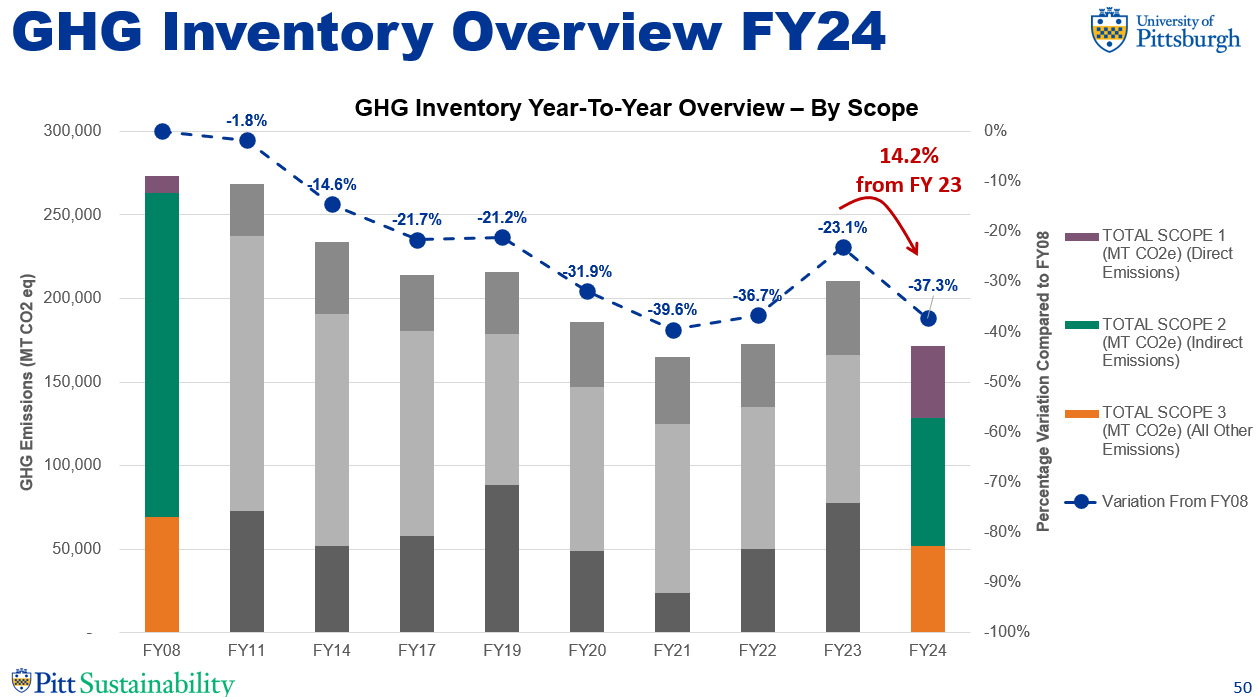
The University’s latest Greenhouse Gas (GHG) Inventory indicates the University is on the way to meet its climate-related goals, as shared in Pitt Sustainability’s July update.
“Having our fiscal year 2024 greenhouse gas inventory results reflect a drop of 37.3% below our 2008 baseline officially puts the University back on track to reach its 50% reduction target for GHG emissions by 2030,” said Aurora Sharrard, assistant vice chancellor for Pitt Sustainability. “The Pitt Climate Action Plan lays out a clear roadmap to achieving carbon neutrality by 2037.
“As a result, individuals and teams across the University are focused on reducing our energy use, cleaning our energy supply and making more low carbon connections,” she added.
The GHG’s fiscal year 2024 (FY24) inventory marks the 10th year of greenhouse gas tracking for the Oakland campus.
The most significant FY24 emissions sources include electricity, steam and air travel, with notable progress made in renewable energy procurement and commuting reductions, Sharrard noted. “Improved travel data also helped ensure our FY24 results are accurate, highlighting a reduction in Scope 3 emissions, which includes travel and commuting.”
Campus buildings contributed 82% of the FY24 fiscal year emissions, an output the sustainability office regularly reviews in terms of building energy use and renewable electricity projections to keep goals within reach.
The results reflect that 33.5% of Pitt’s FY24 electricity consumption was attributed to renewable sources — double the amount from FY23. This includes, but is not limited to, the University’s procurement of 100% of electricity generated by the 20-megawatt Vesper Gaucho Solar farm west of the city near Pittsburgh International Airport.
Noting the focus of her sustainability team and others throughout the Pitt community, Sharrard acknowledged she was more pleased than surprised by the results.
“The Pitt Climate Action Plan lays out a clear roadmap to achieving carbon neutrality by 2037,” she said. “As a result, individuals and teams across the University are focused on reducing our energy use, cleaning our energy supply and making more low-carbon connections.”
Melissa Bilec, professor of civil and environmental engineering and co-director of the Mascaro Center for Sustainable Innovation, attributes the encouraging progress to Pitt’s innovative practices, along with dedication, diligence and teamwork involved in pursuing clear goals.
“While the GHG inventories report quantitative results, the real ‘magic’ is the broad team across the University working toward lowering their individual unit’s carbon footprint,” she said. “Also, Pitt’s continued investment in renewables is a key part of reaching our carbon goals.”
Reflecting work that goes back to 2008, the 10th greenhouse gas inventories report was led by what Bilec called “two talented PhD students,” Federica Geremicca and Isabella Cicco. “Each year we get better data, develop more relationships throughout the University, and strive to make sure we are reporting the annual GHG emissions results as accurately as possible.”
That includes more challenging aspects such as Scope 3 emissions, which the Environmental Protection Agency defines as emissions from activities outside an organization’s controlling scope that indirectly affect its boundaries, or “value chain.” Scope 3 emissions often represent the majority of an organization’s total GHG emissions, according to the EPA.
“For example, even though the FY24 result was 14% lower than FY23, one reason for the reduction was inaccurate air travel data,” Bilec noted. “We were able to make that adjustment and improvement for FY24.”
The University’s success so far is a result of having a comprehensive plan with clearly measurable goals established, she explained.
“At Pitt, we not only have a goal, carbon neutrality by 2037, but also an actionable plan. That being said, the best plans need to be evaluated and adjusted. For example, Pitt's continued growth in physical space and population size may outpace our GHG reductions.
“Thus, a redoubling of efforts may be needed across all categories with a keen focus on more aggressive building energy efficiency retrofits,” she added.
Partly based on a recommendation from the GHG inventory team, the sustainability office will deliver the Pitt Commuter Survey again this fall.
“This will help inform updates to Pitt community commuting assumptions, which haven’t been updated since the FY21 GHG Inventory,” Sharrard noted.
Solar success
In other encouraging sustainability news, the University has received the Pennsylvania Solar Center’s Lodestar Award for a second time. This statewide honor was awarded to 18 organizations this year for their leadership in advancing clean energy across Pennsylvania.
In the past year, Pitt completed rooftop solar installations on Ruskin Hall and the Petersen Sports Complex, which together generate more than 230,000 kilowatt-hours of electricity annually. These on-campus systems complement the University’s off-site partnership with Gaucho Solar.
The University received PA Solar Center’s Lodestar Award in 2023 based on its partnership with Vesper on the Gaucho Solar farm, the largest installation in southwestern Pennsylvania.
“Receiving a Lodestar Award again in 2025 recognizes Pitt’s first rooftop solar arrays on the Pittsburgh campus in 12 years,” Sharrard said, noting that the most recent installations will be reflected in fiscal year 2025. “Stay tuned later this fall for formal announcement of quite a few solar projects.”
Nine campus rooftops are in some stage of solar array installation, with several more in design stage.
Two-wheel movement
In other news, Pitt’s newest interactive POGOH Bike Share Dashboard highlights how students, faculty and staff have used Pittsburgh’s bike share system since the Pitt benefit launched in 2019. The dashboard breaks down trips by rider affiliation, bike type (pedal vs. electric assist), and usage trends over time in support of Pitt’s goal to make 55% of commuting trips to campus active or shared by 2030.
Through Thursday, July 31, Pitt students and employees can take free, unlimited 30-minute POGOH bike rides across the city. Click here to activate your benefit.
“As Pitt’s biking culture continues to grow, we’re seeing record-breaking POGOH Bike Share ridership each year,” said Lucy Klug, mobility specialist in Pitt’s Office of Mobility. “The new dashboard helps us track where and when the Pitt community uses POGOH bikes, on and off campus, with data going back to 2019.”
“It’s clear from the data that POGOH is a convenient and reliable option, and we’re excited to use it to guide future decision-making.”
Also, for University employees interested in advancing their professional education, a new webpage now highlights sustainability-related credentials that are relevant across disciplines. The page supports a new goal in the amended 2025 Pitt Sustainability Plan to “enhance mechanisms for employees to obtain University-sponsored sustainability professional education and credentials relevant to their fields.”
Offered through the Faculty and Staff Development Program, the free Sustainability Professional Development Certificate also remains available to all employees.
Shannon O. Wells is a writer for the University Times. Reach him at shannonw@pitt.edu.
Have a story idea or news to share? Share it with the University Times.