
By SUSAN JONES
No actions were raised for a vote at the Dec. 9 Board of Trustees meeting, but the trustees did hear a report from Nicola Foote, dean of the David C. Frederick Honors College, on the goals and successes of the Honors College and how recent donations are helping achieve these.
Chancellor Joan Gabel also gave updates on several Pitt initiatives and shout-outs to the accomplishments of faculty, staff and students. She shared this same report with Senate Council on Dec. 11 (see related story).
Pitt’s Honors College is one of the oldest in the country, with honors courses dating back to the 1950s and official establishment of the University Honors College in 1987.
But the pace of growth has picked up steam since 2022, when David C. Frederick and his wife, Sophie, gave a multi-million-dollar gift to Pitt to benefit the college. In 2024, the newly renamed Frederick Honors College was expanded to Pitt-Greensburg, and earlier this year, the college received a $30 million gift from alumnus Michael Rees. This money will be used to expand the Chancellor’s Scholarship program and help attract outstanding first-year students and support them through their undergraduate degree.
“But during that whole time, our mission has remained the same — to advance the needs of the most talented, capable and intellectually curious students at the University of Pittsburgh and to help them be the best that they can possibly be,” Foote said.
Since 2018, the number of honors students has increased more the 600%, she said, with 3,500 students this year.
These students are mainly in the honors joint degree program, which is compatible with every undergraduate major. There also is an honors distinction path or students can pursue a bachelor’s of philosophy, or BPhil degree.
Foote said the BPhil is “one of the most prestigious undergraduate degrees available anywhere in the world. We’re one of only a handful of institutions to offer a BPhil.” Others include Oxford University in England, Northwestern University and Penn State.
For the class that enrolled this fall, the Honors College received 10,000 applications for an anticipated 700 spots. They ended up with 805 enrollees. Their qualifications included averages of: 4.5 GPA; 1,501 on the SAT; and 34 on the ACT.
Foote said they have a very strong balance of in-state (61%) and out-of-state (39%) students, “so we’re both supporting the best students in the commonwealth and recruiting students nationwide.”
The Greensburg honors program also has seen growth from 11 first-year students in its inaugural year to 54 this year, plus 11 internal transfers. There are a total of 103 students in the Greensburg program.
Foote cited some other key statistics about the Honors College:
-
96.6% first year retention rate
-
94.4% honors completion rate, which Foote said were among the highest in the nation, compared to a national average of 55%
-
100% of students complete experiential learning, including research study abroad internships.
-
98.3% post-graduation placement rate
The work being done at the Pitt’s Frederick Honors College is starting to get more national notice too. College Transitions ranked Pitt 11th among top honors colleges and Town & Country included Pitt in its list of 15 universities with the best honors programs.
Attracting top students
Foote said that the gift from Rees — Pitt’s youngest transformational alumni donor at 50 and the billionaire co-founder of private equity firm Blue Owl — will be used to endow the newly renamed Rees Chancellor’s Scholarships in perpetuity. Rees was a Chancellor’s Scholar at Pitt, where he earned dual degrees in engineering and politics and philosophy.
“He almost went to another university we won’t talk about — somewhere else in our state,” Foote said. “He was personally recruited by G. Alex Stewart (founding dean of the Honors College), offered a Chancellor’s Scholarship, and it changed his life. He won a Goldwater Scholarship, so he’s passionate about national scholarships, and he wants to pay that success forward.”
Chancellor Gabel said at Senate Council that in addition to giving Honors College students full financial support, the Rees Chancellor’s Scholarships will look “holistically identifying the opportunities for students in the college and making sure that resources don’t stand in the way of accessing those opportunities.”
She said working with Rees was “a really wonderful process to go through with someone who is a very innovative thinker and really cares about students and cares about the institution, and to come together on how to … enhance a program that’s already so wonderful.”
Foote said Rees was motivated to give the donation by the Plan for Pitt 2028 goal to increase distinguished student awards.
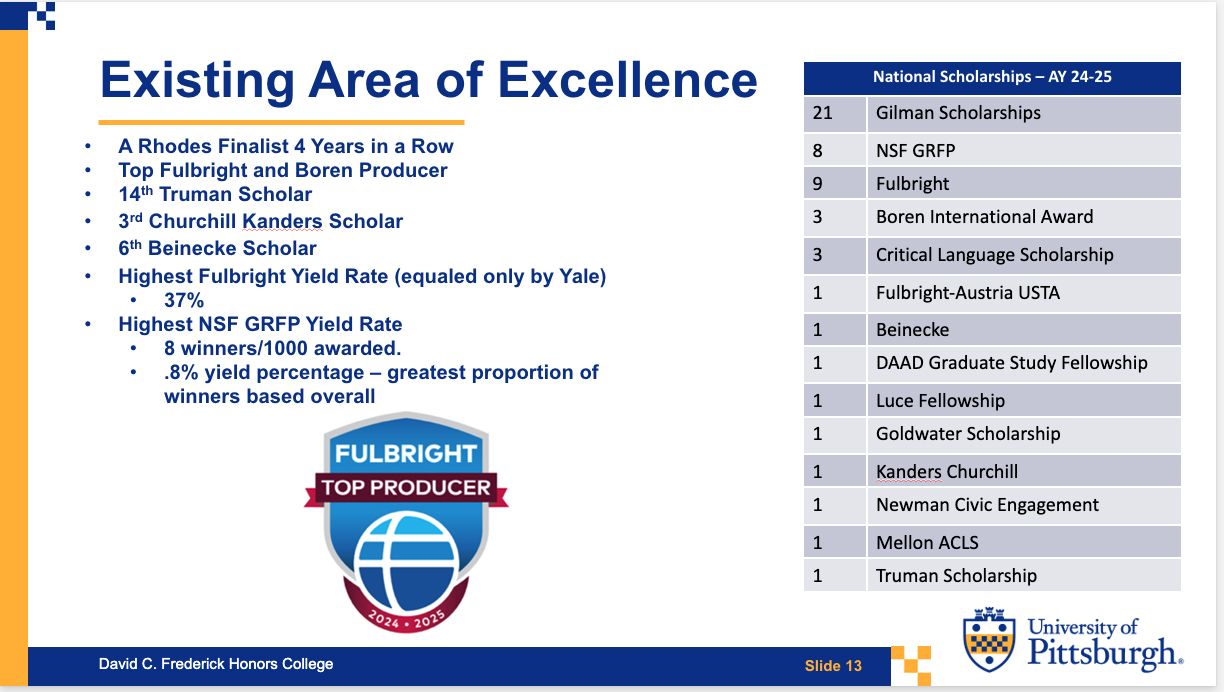
“Our goal is to work together to become the number one public university producer of national scholarships,” she said, noting that Pitt already is a top producer of Fulbright and Boren scholars, has been a top producer for the Obama Chesky Voyager award and had a Rhodes finalist four years in a row.
“In the Fulbright, our yield rates are the highest in the nation,” Foote said. “Only Yale even equals us.”
To build on these successes, Foote said a committee has been formed that will be a “comprehensive cross-University effort to build on an extraordinary area of strength for us and help us support even more students into applying and competing for these awards.” She said they’ve also identified faculty liaisons in every undergraduate major at Pitt, who will be the point people for generating applicants.
Another initiative is a program at Oxford backed by David Frederick, where Pitt’s U.K. scholarship finalists go to Oxford ahead of submitting their applications. “They get to be together that summer, meet with potential mentors and work on their applications,” Foote said.
The Rees family donation also is allowing the Honors College to develop innovative recruitment strategies, some borrowed from athletics.
Foote said they are “reimagining our timelines and our approach to Merit Scholar recruitment. We are starting to look for those scholars much earlier in sophomore and junior year. We are being extremely proactive. We are identifying where are the best academic students in the nation. We are going to robotic tournaments, Model UN tournaments, and looking for those students who are competing in academic fields. .... We are meeting their families and helping them learn about all the amazing things that Pitt and the Frederick Honors College have to offer.”
The Rees donation also has allowed the Honors College to hire new support staff, including Cameron Saddler, a Pitt alum and 2012 captain of the Pitt football team, to act as recruitment lead. Other hires will help students compete for national scholarships and support them while they’re at Pitt.
David Frederick, who also sits on the Pitt Board of Trustees, praised Foote and her team. “It’s always an enormously gratifying thing as someone who’s tried to give back to the university to see what can happen with those resources. And I also want to publicly thank Michael Rees and his family. … Their gift is going to be an absolutely transformative bolt of resources into an already growing and phenomenal program. And what Michael and his family have done is something that I just couldn’t be happier about, and I hope that it will help inspire other people to be thinking about ways that they can promote excellence at the University.”
Susan Jones is editor of the University Times. Reach her at suejones@pitt.edu or 724-244-4042.
Have a story idea or news to share? Share it with the University Times.