
By SUSAN JONES
The Senate’s Student Admissions, Aid and Affairs committee received two very different reports at its Dec. 13 meeting — one on enrollment and one on a sexual misconduct survey.
Marc Harding, vice provost for enrollment, reminded everyone what a difficult year the Office of Admissions and Financial Aid has been through. They had to deal with a serious delay in FAFSA forms going out and the impact of the U.S. Supreme Court ruling that banned the use of race-based criteria in admissions decisions.
“We’re behind two years ago,” he said about the FAFSA forms. “We’re in better shape than last year, but it’s still not where we’re supposed to be.”
He said the “bottom line is it is delayed this year.” The FAFSA forms have previously been available to applicants in October, but they just opened a couple weeks ago. And typically Pitt sends its financial aid offers to regional campus students by now, but that hasn’t happened yet.
Harding said there are other upcoming issues that his department will be looking at, such as any changes the new presidential administration makes to the Department of Education and the decline in the number of high school students over the next decade. The office also is keeping a close eye in the increasing number of private and public schools that are offering free tuition to families making less than a certain amount — $75,000 at Carnegie Mellon and $125,000 for in-state students at the University of Michigan.
Despite these issues, Harding and Kellie Kane, associate vice provost for enrollment, said Pitt had a record number of applications for 2024-25 — a total of 60,893 — and expects to top that number for the 2025-26 school year. Kane said they are trying to increase recruitment of non-Pennsylvania students, because the state will see one of the larger declines in high-school age students.
The total enrollment for fall 2024 was 32,431, with numbers up on the Oakland campus and continuing to go down at the regionals. The full-time equivalent enrollment changes since 2019:
Undergraduate, Oakland: 18,686 in fall 2019 to 20,418 in fall 2024
Undergraduate, regionals: 5,215 to 4,075
Graduate/professional, Oakland: 8,044 to 8,319
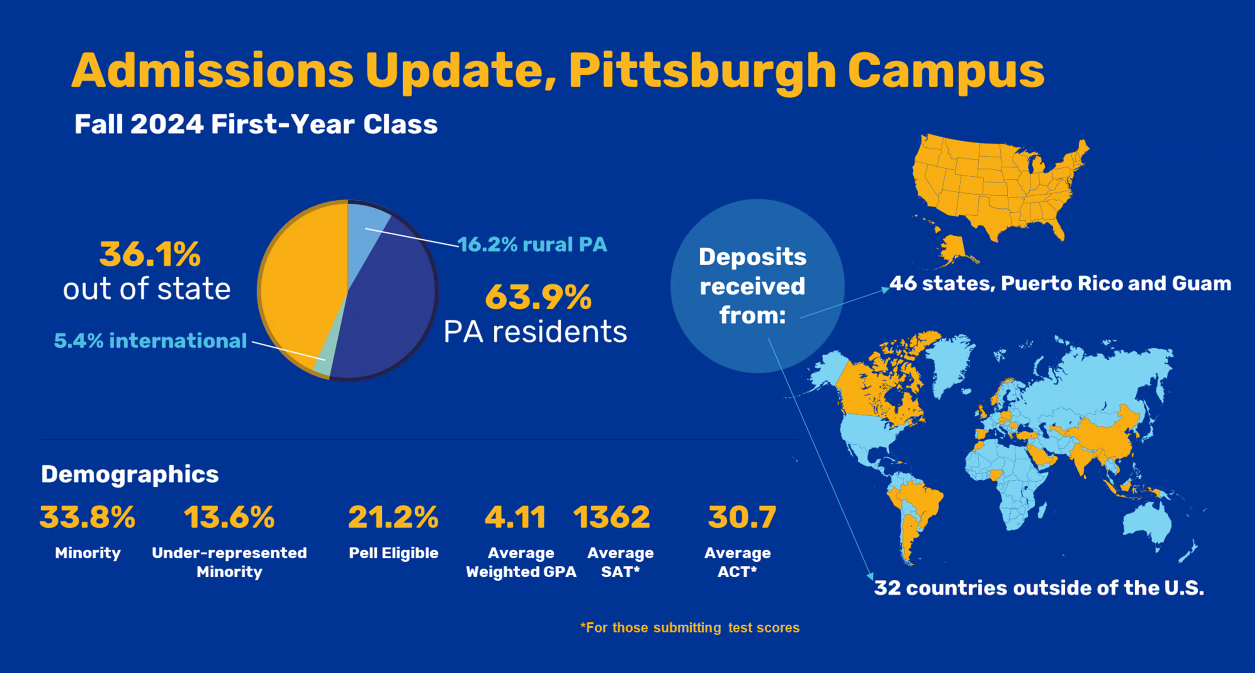
Other statistics about the fall 2024 first-year class in Oakland:
-
63.9% Pennsylvania residents and 36.1% from out of state
-
5.4% international students
-
16.2% from rural Pennsylvania. Kane said a grant has allowed them to hire a second recruiter to focus on the rural areas of the state.
-
33.8% minority and 13.6% under-represented minority
-
21.2% are Pell-eligible, a number that has been growing since Pitt started its Pell matching program, Pitt Success, in 2019.
-
4.11 average weighted GPA
Harding also noted that there are several programs designed to attract a wide variety of students. These include a partnership with the Posse Foundation, which will focus on students from the Mastery Charter Schools in Philadelphia and New Jersey, and improved transfer pathways with the help of School of Education Dean Eboni Zamani-Gallaher, who has expertise in this area.
Pitt also has decided to remain test-optional through 2028, so it will have several years of data to analyze the impact of not requiring the SAT or ACT for undergrads.
Sexual misconduct awareness survey
The Higher Education Sexual Misconduct Awareness Survey was administered by Westat at all Pitt campuses this year, from Feb. 19 to March 24.
“This survey builds on the legacy of the 2019, AAU campus climate survey on sexual misconduct and sexual assault,” said Clyde Pickett, vice chancellor for equity, diversity and inclusion, “and provides institutions, including ours, data and insights that inform how we advance evidence-based policies and support services, and more specifically, how we advance interventions to create safer and more inclusive campus environments.”
Carrie Benson, director of sexual violence prevention and education in the Office of Equity, Diversity and Inclusion, presented the key points from the survey. She said the survey “will certainly drive a lot of the work that I do over the next few years on our campus.”
Pitt was one of 10 schools participating in the survey. The others were California Institute of Technology, Georgetown University, Harvard University, Iowa State University, Stanford University, University of Pennsylvania, University of Virginia, Washington University at St. Louis, and Yale University.
At Pitt, about 15 percent of students responded to the survey, with more female-identifying students and grad students responding. Benson noted that even though the survey gives high-level data, that “every time we’re looking at a percentage, that represents a person who has experienced some form of sexual misconduct on our campus, and that is a traumatic experience that could have greatly altered their experience here at the University or in their life as a whole.”
Key data from the report, which is hundreds of pages long:
Decline in trust: About 54% of Pitt students who responded felt that campus officials would take reports very or extremely seriously, and 43% said campus officials would conduct a very or extremely fair investigation. Both are these are declines from 2019.
Benson said this “decline in trust” is an area that “we have some work to do on our campus to make sure that we are doing the work to really repair that trust with our students and thinking about how we’re working with them, to ensure that they feel comfortable engaging in resources and reporting.” This same decline is being seen at other AAU schools as well.
Victimization: The report found a decline in the numbers of students who have experienced some type of sexual violence during their time at Pitt, but Benson said, “What I want to draw our attention to is that while we are seeing these declines, that 20% of our female-identifying undergraduate students, 29% of our trans and non-binary undergraduate students, are still reporting experiencing sexual violence during their time at Pitt. … We are pleased to see that there is a decrease in victimization, though, recognizing that we still have a tremendous amount of work to do.”
Intimate partner violence: While the aggregate rate of students experiencing intimate partner violence at Pitt is about 12% and has come down since 2019, Benson said, Pitt does have the highest rate of intimate partner violence among the AAU schools that conducted the same survey. She said it’s an area they will be focusing on.
Perpetrators: The survey found that the large majority of people committing sexual harassment of students is other students. But the second largest percentage is faculty. “So certainly we’ll be working to continue to address these types of issues on our campus, with our students, staff and faculty, recognizing that we all need to be engaging in this work,” Benson said.
Find more details about the report on the Office of Equity, Diversity and Inclusion website.
Susan Jones is editor of the University Times. Reach her at suejones@pitt.edu or 724-244-4042.
Have a story idea or news to share? Share it with the University Times.