
By SHANNON O. WELLS
Launching into the 2025 Pitt Senate Plenary address on academic freedom and classroom discourse, keynote speaker Michelle Deutchman offered a quick primer on First Amendment rights.
“I think we have to be able to understand free speech in order to distinguish it from academic freedom,” she said. “My experience over the past two decades has been that people, even at the highest levels, are not familiar with fundamentals of the First Amendment, including the five rights covered (and) whether or not the First Amendment applies to social media platforms (or if) ugly speech is protected.”
Deutchman, executive director of the University of California National Center for Free Speech and Engagement, cited a recent Annenberg Public Policy Center survey that found only 48% of respondents could name up to two of the five rights expressed in the First Amendment. Only 7% of respondents could name all five, while one in five couldn’t name any.
“I’m going to ask you to think to yourselves, ‘What are the five rights covered by the First Amendment?’” she said. “I know you’re all thinking the fifth one is the hardest.”
After providing the answer: religion, speech, press, assembly, and the right to petition the government for grievances, Deutchman quipped, “I’m not going to ask you how you did.”
Deutchman anchored this year’s annual plenary discussion on the theme of “Academic Freedom in the Classroom: Strategies for Discourse and Dialogue,” that took place March 11 in the William Pitt Union.
Hosted by Senate Council President Robin Kear, the event — which was open to the Pitt community — began with comments from Chancellor Joan Gabel and concluded with remarks from Provost Joe McCarthy.
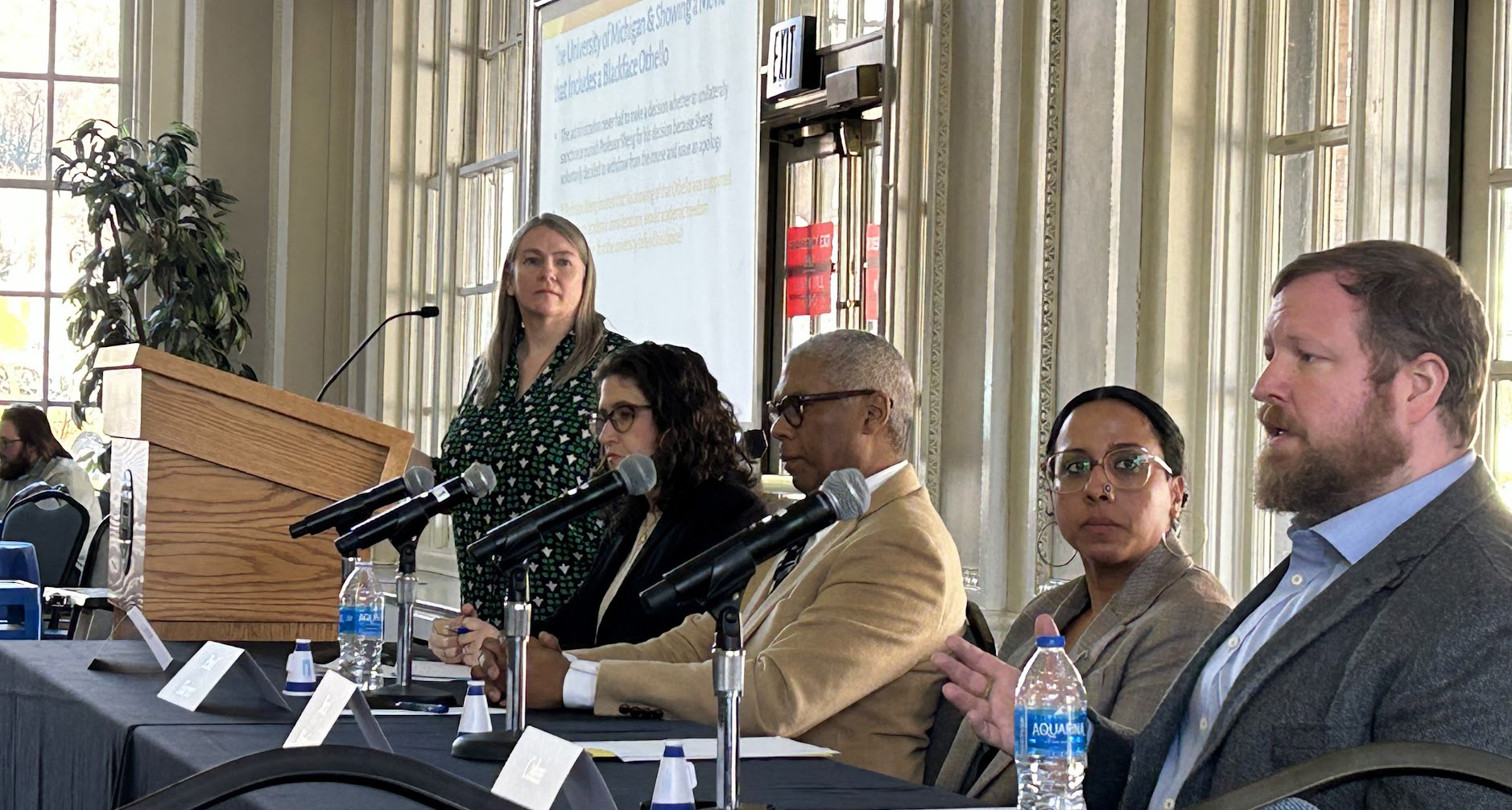
Pitt panelists included Paul Harper, associate dean for inclusion, engagement and international affairs at the Katz Graduate School of Business; Calum Matheson, chair of the Department of Communication in the Dietrich School of Arts and Sciences; and Sera Mathew, director of equitable and inclusive teaching in the University Center for Teaching and Learning.
If academic freedom seemed a reasonably timely topic for a university forum when the Senate Plenary was planned last fall, now — with the Trump administration’s barrage of executive orders threatening the future of federal funding for higher education-related research and programs — it’s closer to being spot on.
Chancellor Gabel, in thanking those on the Discourse and Dialogue Steering Committee for their event-planning work, repeated a comment from Kear about the topic being a “no brainer.”
“In the few months since (the plenary) was being planned, the foresight in picking this as the topic by Robin and Senate leadership I think speaks for itself in the importance of the conversation that we’re likely to have today,” Gabel said. “Amidst very difficult times and a very difficult topic, you are nonetheless in for a treat in that we have real experts with us today from our campus community.”
Gabel, who said she’s “had the pleasure of getting to know” and hearing her speak before, called Deutchman a “tremendous subject-matter expert on the First Amendment and its particular role within the classroom, and on campus in general.”
‘Precarious moment’
Deutchman, who said this was her first visit to Pittsburgh, called the prevailing socio-political climate an “incredibly terrifying, challenging and demoralizing moment” in which to discuss academic freedom, discourse, dialog and open expression.
She likened the situation to the post-World War II era of political repression when unfounded accusations of communist sympathizing infected the U.S. Congress.
“Like many others, I believe that colleges and universities are facing the greatest crisis since the (Senator Joe) McCarthy era,” she said.
“Higher education faces legislative assaults from local, state, and now national politicians who question the value of a post-secondary degree; a vice president that’s referred to professors as ‘the enemy,’ culture warriors who are using the banner of free speech to infuse political agendas on campus,” she said. “The stakes are real, and they are (threatening) livelihoods and funding (with) the specter of punishment and retaliation for using words in classrooms like ‘diversity’ or ‘gender ideology.’”
In this “precarious moment” when academics are “pulling words off of websites” and removing readings from their syllabi, policy makers, advocates, administrators, faculty and students are all asking each other, ‘What can we do … to safeguard our institutions,” Deutchman said.
“One thing we can do is what we’re doing here, which is to be in a community and to talk about the hard issues, like, ‘How do we cultivate an environment where civil discourse thrives?’ Doing this takes a lot of courage.”
Some universities, including the University of California, have their own entities dedicated to academic freedom and free speech.
The UC National Center for Free Speech and Engagement, which Deutchman leads, offers a national fellowship program open to anybody in the United States, with applications currently being accepted. “We have a conference, we have workshops, we have a monthly speech practice — lots of resources,” she said.
Referring to the history of social and political activism at her alma mater, the University of California at Berkeley, Deutchman referenced the 2017 protests and clashes there that started when Donald Trump supporter Milo Yiannopoulos was scheduled to speak on campus.
“This was a moment, you may recall, when it was actually administrators who didn’t want university students and faculty to have free speech rights on campus. And how different that was when the center was formed in 2017,” she said, showing slides depicting unrest and violence at several campuses through the past 20 years or so. “Things were set on fire. There was vandalism. There was violence.”
In those cases, it was often students who didn’t want speakers visiting campus, putting administrators and faculty members in the position of saying, “‘Wait, as a public university, we have to safeguard the rights of people who are coming with voices and ideas that we don’t like,’” she said.
The First Amendment says the government cannot prohibit people from saying certain things and is not able to “punish you or retaliate against you once you speak,” she noted. That goes for public universities, but not social media companies and other private companies.
“Now, social media companies like to think, and want you to think, that the First Amendment applies, because they say, ‘Oh, we can’t really (moderate content) because of the First Amendment, when, in fact, that is actually untrue,” Deutchman explained. “Private companies can moderate content as much as they want.”
Neutral ground and responsibility
To grasp the bigger picture in what’s happening today requires the ability to understand “why there is value in protecting ugly speech. Of course, we don’t want to live in a society where the government gets to decide what is considered hateful and what is not.”
Unfortunately, she noted, some state and congressional legislators have decided that certain ideas are dangerous and polarizing — and therefore must be prevented.
“They’re using the power of their elected office to censor speech, which is exactly what the First Amendment is supposed to be precluding,” she said. “We want to be careful whenever we go down the road of thinking we want to censor others. Because what I would say is, ‘You may want to censor somebody else’s speech today, but for sure, it will be your speech tomorrow.’”
Deutchman said universities are crucial in imparting the idea that rights come with a great deal of responsibility.
“(In) American society, we’re so focused on rights, which is the, ‘I’m allowed to do this, and you cannot stop me!’ part of free speech. That means ‘Forget the other side,’ which is responsibility.”
“Just because you have the right to do or say something doesn’t mean that you should,” she said. “And I think that universities of higher learning have a responsibility to help students and others understand how you make those rights responsibly.”
Valuable debate
During the plenary’s panel discussion, Pitt’s Calum Matheson emphasized the importance of fostering a “culture of good debate.”
“We should teach it in classrooms. We should model it in department colloquium. We should embrace the ethos of intellectual bravery that it requires,” he said. “And I’m saying ‘good debate’ for a reason: We already live in a culture of debate, just not a very good one.”
Matheson noted that many who value discourse and dialog are nonetheless apprehensive about debating.
“They’re afraid that if we overemphasize debate, we’re encouraging polarization, sophistry and discord,” he said. “The problem is that all of that stuff exists already. Cultivating debate does not mean exacerbating problems. It means reinforcing the techniques of deliberation that underpin not just economic inquiry, but of democracy itself.
“Letting the prevalence of bad debates deter us from fostering good debate, it’s like saying that there’s a lot of snake oil out there, so we shouldn’t study medicine.”
Pitt panelist Paul Harper called the concept and practice of academic freedom the “original diversity, equity and inclusion strategy.”
He noted the significance of the 1940 Statement of Principles on Academic Freedom and Tenure recognizing the “purpose of the university to serve the common good … and to not tolerate (the dominance of) orthodoxy.
“The common good presupposes the presence of different perspectives,” Harper said. “Orthodoxy assumes the opposite. Here, academic freedom is already being connected to a higher, unified purpose.”
Harper cited the importance of the late Pitt Provost Jim Maher’s 2002 statement recognizing the “problem of orthodoxy” that existed for American colleges.
“Maher discussed the changes in American society and the resulting growth in the diversification of our University,” he said. “(Maher) specifically talks about a challenge to extend notions of academic freedom posed by the virtue of thought and expression. … He also discusses at great lengths the University’s goal to maintain traditional forms of academic freedom.”
Provost Joe McCarthy closed out the Senate Plenary by noting his pride in Pitt as an institution that “has a history of decades of continuous exploration of academic freedom, because,” he said, “the way that we do this — in changing times in a way that best serves our students — does, in fact, evolve.
“So we need to continually be introspective about it, consider how effectively we’re doing this, and continue to evolve so that we’re really at the forefront (of it) as an educational institution.
“That we’ve had decades of this introspection — just in recent memory, and that there’s really no sign of us stopping. That we have this kind of investment from the entire University community. That this was THE topic that we wanted to talk about in the Senate Plenary,” he noted. “I think it’s something that we as an institution should be proud of.
“Thanks again to all that were responsible for bringing it to bear.”
Shannon O. Wells is a writer for the University Times. Reach him at shannonw@pitt.edu.
Have a story idea or news to share? Share it with the University Times.