
By SHANNON O. WELLS
If there was an unofficial prerequisite for hiring a property manager at the Pitt Surplus department, working for more than 10 years at Pittsburgh’s preservation-minded Construction Junction would be a tough one to beat.
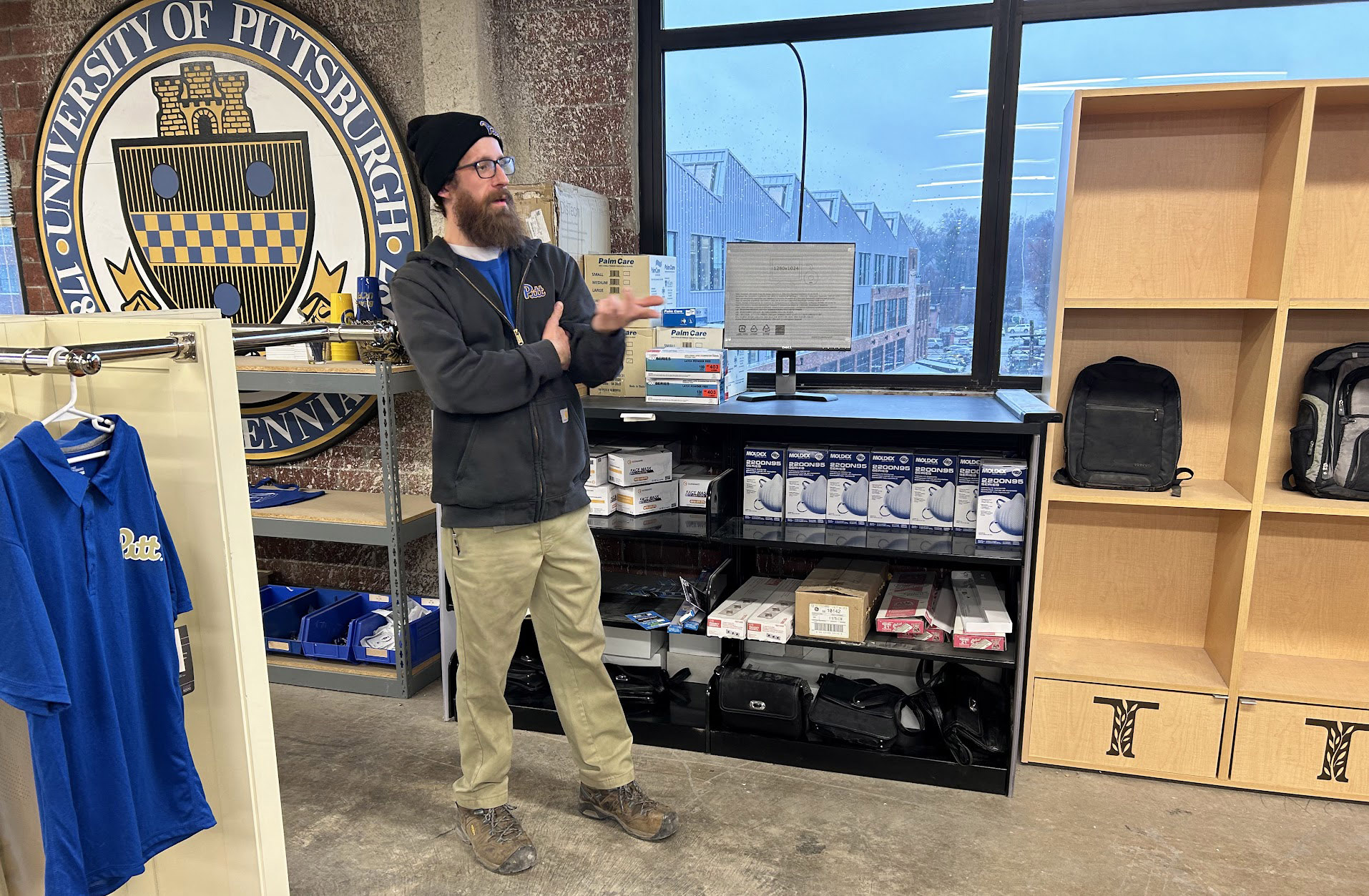
 Enter Karl Zellars, who came on board to manage Pitt Surplus in November. The 2009 Pitt graduate worked for 11 years at Construction Junction, located a virtual stone’s throw from the Surplus warehouse facility at 7500 Thomas Blvd.
Much of the well-known nonprofit’s mission, reducing waste through reclaiming and selling used building materials, is echoed at Pitt Surplus, where all manner of campus-based furniture, equipment and accessories is sent for repurposing.
Zellars, who started his career in marketing for a financial advising firm before being laid off, said he was drawn to his more recent roles through a passion for preserving materials that are increasingly hard to find — or simply headed for oblivion.
“I was always environmentally minded, but I got really passionate about the materials that I was seeing there, and really firmly believe in what I’m doing in keeping things out of the landfill,” he said of Construction Junction. “It’s a visceral reaction. I was going into abandoned houses — buildings that are falling down — and I viewed myself as more of a miner, because I believe that a lot of these (materials) are going away.”
For example, a door from the 1960s “is completely different than a door today … and has more uses,” he added, “because it’s not filled with composite material.”
Such “mining” experience serves Zellars well in managing the cavernous sprawl of Pitt Surplus, part of the University’s Business, Hospitality and Auxiliary Services’ Logistics division.
The fifth-floor showroom is where used, yet still useful, items from Oakland wind up, ideally to find new homes and lives: office furniture, file cabinets, microscopes and lab equipment, TVs of various sizes, portable stereo “boom boxes” and DVD players, along with a bevy of smaller miscellany, from palettes of petri dishes and N95 face masks to computer cords to accommodate any conceivable connection needs.
There's also plenty of oddities, like an upright piano and a vintage, foot-pump Singer sewing machine. The latter was used as a prop in a 2016 Pitt Department of Theatre Arts production of "Intimate Apparel," whose main character, Esther, is a black seamstress living in a boarding house who makes her way by sewing intimate apparel for wealthy white patrons as well as poor prostitutes.
Zellars and his staff evaluate all the items for redistribution to new campus locales or resale to the public, via an online buying and auction site or in-person visits to the showroom.
A good place to shop
Compared to his roles at Construction Junction, “this job is very similar, as far as managing the sale of secondary or second-hand furniture, equipment, that kind of thing,” Zellars said. “But one of the big things that I’m going to work on is actually increasing the amount of materials that Pitt (will be) salvaging, selling, or at least partnering with other nonprofits to disperse that material to them — just keeping more stuff out of the landfill.”
That includes electronics, computer screens and software components. “We break ‘em down, and send them to vendors,” he said. “We have to remove and wipe the software. A lot of the screens are out of date. Macs (by Apple Corp.) are more difficult (to repurpose).”
COVID pandemic-era remnant items, including petri dishes, latex gloves and face masks, prove an even harder sell. “We have eight pallets purchased in bulk during the pandemic,” he said for a total of 8,400 masks, along with 42,000 petri dishes, some of which may sell at a fraction of their costs via auction. “That’s a lot.”
For more conventional items, anyone can come by during the warehouse’s regular hoursÚ from 7:30 a.m. to noon and 12:30-3:30 p.m. Tuesdays through Fridays. A security guard admits customers downstairs, and Zellars or a Surplus employee will assist them in the showroom, where cash, checks and charge cards are accepted.
Lindsay Patross, a self-described “thrifter” and “antiquer” who lives near the facility, makes the warehouse part of her regular browsing rounds. On a recent afternoon, while seeking out a comfortable chair for her elderly father, she became enamored by a few large, framed landscape photographs on the showroom wall.
“I’m just a superfan,” she said of Surplus. “Some items are super unique. Some of the tables and larger pieces of furniture are stunning. There’s stuff you might find in an antique store. And you can’t beat the price.
“It’s like the best thrift store in Pittsburgh.”
Sustainable cycle
While Pitt Surplus has an army of loyal customers, Zellars said he started noticing a demographic shift at play during his time at Construction Junction.
“There’s a generational difference of people who were enthusiastic about this type of thing, and that hasn’t translated (to today),” he explained. “(Younger) people who are now moving into home ownership, they’re not buying used materials.
“Obviously, it’s a different market here at Pitt Surplus. The University is our No. 1 customer, but we don’t get many students,” he added. “That is one thing I’m trying to build awareness of, getting students to actually start coming out here, or offering products (online).”
Even with such changing trends, Surplus’s statistics tell an impressive tale of sustainability. Through the past 10 years, the department has sold 960 desks, 6,598 chairs, 1,140 file cabinets (vertical and lateral), 1,024 tables and 438 bookcases, among many other items.
In 2024, 564 transactions took place on the sales floor and via online auction at GovDeals.net. During the most recent fiscal year, Surplus recycled:
-
215,567 pounds of scrap metal
-
10,312 pounds of toner cartridges
-
24,080 pounds of printers and fax machines
-
7,608 pounds of TVs
-
42,282 pounds of generic eWaste
-
14,089 pounds of textiles
Zellars is working with the University’s Design, Planning and Construction department to consider the vast array of products Pitt uses and what will be their fate 15 or 20 years from now. He’s also looking into coordinating with other area universities that lack their own surplus departments.
“We will potentially be working with them to actually bring their materials in here, and figuring out some kind of arrangement there,” he said.
Another aspiration is identifying more of the materials that can be salvaged and sent to other reuse-based organizations such as Global Links, Habitat for Humanity, and Construction Junction, and being in contact with other nonprofits looking for certain items or materials.
“If I recognize those on a project that is taking place at the University, I will be able to disperse more because there’s a surplus here — we only have so much room, right? — and we also have a customer base,” he noted. “We don’t sell used lumber, but Construction Junction (does), so there’s no reason why we shouldn’t try to salvage those things when an existing relationship with them already is there.”
A valuable operation
Tom Heidkamp, one of Zellars’ predecessors who retired as Surplus property manager in 2019 after 45 years at Pitt, recalled the early days unloading trailer trucks with office furniture and sorting through the contents.
As the campus acquired more buildings during his career, more University departments moved out of the Cathedral of Learning, leaving their old furniture behind. Heidkamp and crew collected it in Pitt’s warehouse.
“We saw value in it, to save the University money, in lieu of buying new,” Heidkamp recalled in a University Times story just before his retirement. “That was the basic concept for what became Surplus property,” which by its very nature “is a green department.”
Adam Morrison, a Pitt Surplus specialist for the past two years, said he enjoys having a role in preservation and sustainability.
“I just think it’s nice being able to help prevent (excessive waste). If (Surplus) wasn’t there, all this would be in the landfill,” he said, gesturing toward the vast showroom beyond his desk. “A lot of ‘garbage’ we make ‘not garbage’ … even if it takes a while on its way to being recycled.”
Settling into his new position, Zellars, who has lived in Pittsburgh since 2007, said he’ll remain focused on making Pitt Surplus less of a “best-kept secret” and more of a go-to for quality, gently used equipment, furniture and accessories.
“I want to expand the number of transactions, expand our reach and get more people to actually shop here,” he said. “I mean, the average commercial office desk (costs) probably around $700, and we sell them for $125, if not less.
“The value there is that it ultimately does save the University money by offering this. And that cost is really just helping us to keep this kind of operation moving.”
Shannon O. Wells is a writer for the University Times. Reach him at shannonw@pitt.edu.
Have a story idea or news to share? Share it with the University Times.